Natural site
Quiberon Côte Sauvage
Quiberon · Morbihan
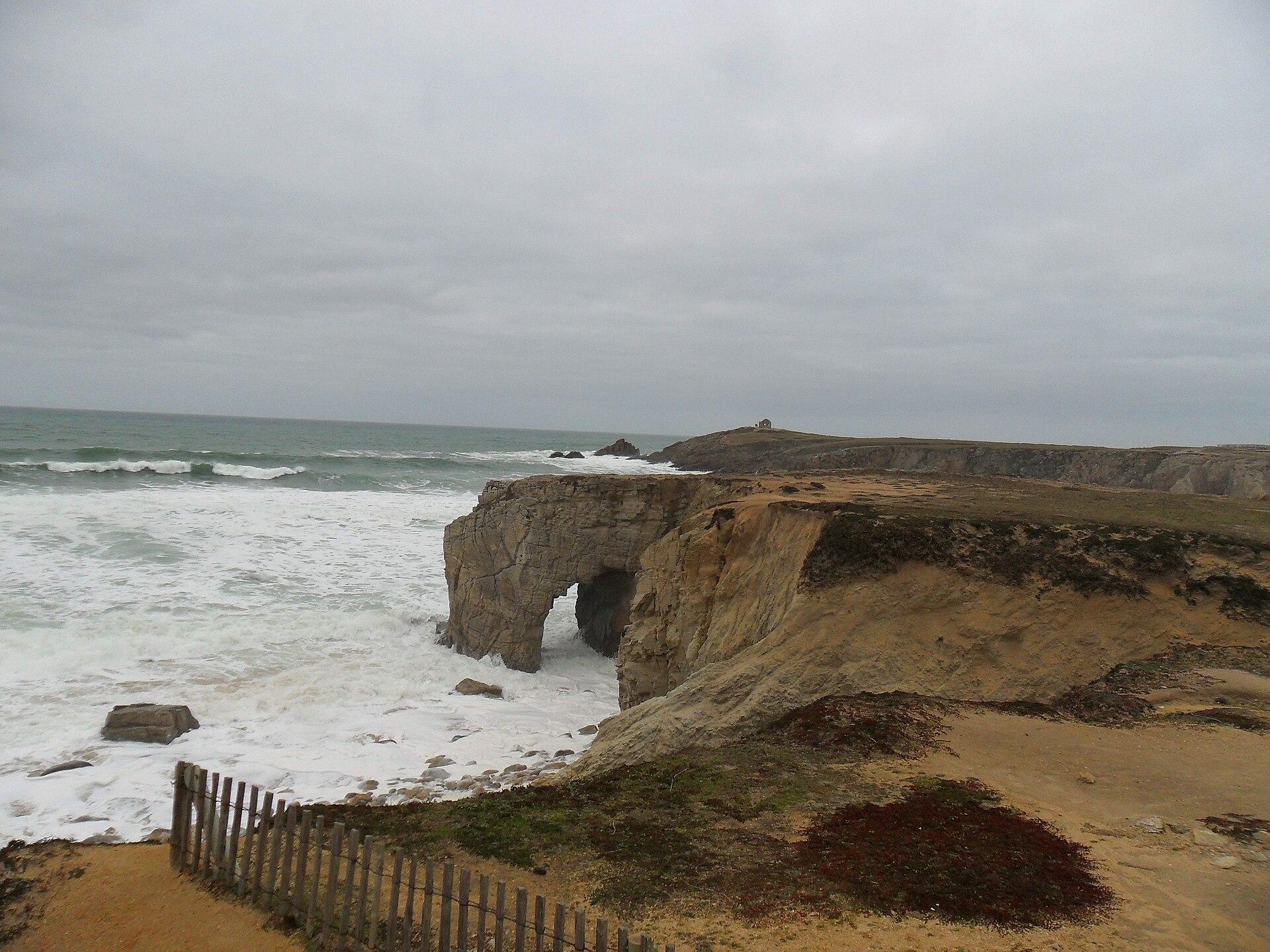
Nearly ten kilometres of granite cliffs facing the Atlantic, from Portivy to the Château Turpault: the Port-Blanc arch, the Pointe du Percho, heathland and megaliths. Swimming strictly forbidden.
- Suggested time
- 1 hour to half a day
- Type of place
- Rocky coast, granite cliffs, heathland and dunes
- Atmosphere
- Oceanic and wind-battered, spectacular in rough weather, golden at sunset
- Getting there
- Quiberon and Saint-Pierre-Quiberon, on the west side of the peninsula. The car parks have been moved back from the cliffs: for the Port-Blanc arch, the Pointe du Percho and the dolmens, park at Kergroix, redeveloped in 2026. The other car parks along the coast have height barriers: campervans go to Kergroix during the day, or to the Port Kerné area in Quiberon (about 100 spaces). By bike, use the greenway parallel to the coast, never the footpath. In summer, the Tire-Bouchon train (Auray, Saint-Pierre-Quiberon, Quiberon) avoids the traffic jams on the Penthièvre isthmus. Free access.
Who this place suits
- With family
- 8/10
- As a couple
- 10/10
- With friends
- 9/10
- Solo
- 9/10
- With a dog
- 8/10
- Reduced mobility
- 4/10
These scores are calculated from what the page records: official rating, facilities, difficulty, duration and location. They are a guide, not a substitute for contacting the venue, especially about accessibility.
About
The Côte Sauvage (wild coast) is the whole western side of the Quiberon peninsula: nearly ten kilometres between the little port of Portivy in the north and the Château Turpault at the entrance to Quiberon. A few kilometres from the calm bay lined with beaches, it takes the full force of the westerly wind and the Atlantic swell. Cliffs more than twenty metres high in the north, headlands, coves, caves, arches, heathland and dunes: the name describes the landscape, and also the power of the sea. The rock is a pale two-mica granite, formed about 300 million years ago deep inside the ancient Hercynian mountain range. Erosion wore away the mountains and exposed their roots, which the swell has been attacking ever since through every crack. At the top of some cliffs, towards Saint-Pierre-Quiberon, a layer of sand rests on the granite: these are perched dunes, brought by the wind in other eras. The most famous landmark is the Port-Blanc arch, also called the Roche Percée, carved into the cliff and lit through by the setting sun. It is fragile: blocks have already fallen, and access to its foot is forbidden. Just above, the Pointe du Percho keeps the ruins of a customs post and one of the widest views on the coast. Further south come Port Bara, Port Rhu and Le Vivier, where the cliffs gradually get lower. The coast is also a prehistoric site. The two passage graves at Port-Blanc, excavated in 1883 and listed as historic monuments in 1889, contained collective burials and a trepanned skull. The Beg-en-Aud burial mound has been listed since 1927, and the Le Vivier standing stones still include the “Bishop’s Hat”, nearly three metres tall. At the end of the route, the Château Turpault, built in 1904 for an industrialist from Cholet, closes the coast: it is private and cannot be visited. The site has been protected since 1936, is listed as a ZNIEFF natural area, is part of Natura 2000 and of the Dunes Sauvages de Gâvres à Quiberon Grand Site de France, labelled in 2018 and now renewing its label. The Conservatoire du littoral has acquired nearly two hundred hectares here since 1991. Trampling had stripped the heathland bare; the car parks were moved back from the cliffs and visitors channelled onto paths, which let the vegetation return. Today you can find sea holly, shore dock and the highly protected dune hound’s-tongue, as well as the Dartford warbler in the gorse.
What you will see
- Nearly ten kilometres of unspoilt ocean coast, from Portivy to the Château Turpault, with cliffs more than twenty metres high in the north.
- The Port-Blanc arch, or Roche Percée, the most photographed natural landmark on the peninsula, to be seen from the path.
- The Pointe du Percho and the ruins of its customs post: one of the widest views over the Atlantic.
- Granite about 300 million years old, the root of an ancient mountain range, and perched dunes on top of the cliffs.
- Megaliths by the ocean: the Port-Blanc dolmens, the Beg-en-Aud burial mound, and the Le Vivier and Manémeur standing stones.
- About 8 km of coastal path on the GR34, and a greenway for bikes set back from the coast.
Show 3 more pointsHide
- Facing due west: one of the best places in Morbihan for sunset, from Portivy to Port Rhu.
- Rare plants: sea holly, shore dock, dune hound’s-tongue, thrift and rock samphire on the cliffs.
- The Château Turpault, built in 1904, an iconic Quiberon silhouette (private property, seen from outside).
Practical information
- Parking
- Car parks set back from the cliffs. Kergroix (Port-Blanc), redeveloped in 2026, open to campervans during the day; the other car parks on the coast have height barriers. Port Kerné area in Quiberon.
- Pets
- On a lead on the marked paths. Saint-Pierre-Quiberon: dogs not allowed on the beaches from 1 June to 30 September (2026), except at Le Lizeau.
Tips on the spot
- Swimming is strictly forbidden along the whole Côte Sauvage, including Port Bara, Port-Blanc and Port Rhu: ground swells, currents and rocks put even very strong swimmers in danger, even when the sea is calm. Sea walking is forbidden too.
- Stay behind the barriers: rockfalls happen, and access to the foot of the Port-Blanc arch is forbidden. In 2026, Port Bara beach was closed because of the risk of rockfalls: check before you come.
- In a storm, the show is immense, but one wave can rise much higher than the previous ones: watch from a distance, never from the rocks.
- Our route for half a day: the Pointe du Percho, the dolmens and the Port-Blanc arch, Port Bara, Port Rhu, Le Vivier, then the Château Turpault. With only an hour: the Percho and the arch.
- For sunset, arrive 30 to 45 minutes early, at Portivy, the Percho or Port-Blanc.
Show 5 more tipsHide
- The path is easy but uneven: sand, stones, short climbs and wind. Wear shoes with grip, and keep children away from the edge, which often has no barrier.
- Stay on the waymarked paths: the short grass on the clifftops is a rare habitat, and a few dozen passages are enough to open a new track.
- Dogs on a lead on the paths. In Saint-Pierre-Quiberon, they are not allowed on the beaches from 1 June to 30 September (2026 rule), except at Le Lizeau.
- In summer, leave the car: the Penthièvre isthmus is only about twenty metres wide at its narrowest and gets jammed. The Tire-Bouchon train ran every day from 29 June to 31 August in 2026.
- Drones: protected site and possible airspace restrictions; check the rules before any flight.
Frequently asked questions
Can you swim on the Côte Sauvage?
No. Swimming is strictly forbidden by local order, at Port Bara, Port-Blanc and Port Rhu as everywhere else on the coast. This is not just an unsupervised beach: ground swells, currents, swell and rocks put even very strong swimmers in danger, even when the sea looks calm.
Where does the Côte Sauvage start and end?
It stretches 8 to 10 km depending on where you draw the line, from Portivy in the north, in Saint-Pierre-Quiberon, to the Château Turpault in Quiberon in the south.
How much time should I allow?
An hour for the Pointe du Percho and the Port-Blanc arch, 2 to 3 hours for a good discovery, half a day to follow the coast to the Château Turpault.
Can you go down under the Port-Blanc arch?
No. Blocks have fallen and direct access to its foot has been forbidden. You see it from the coastal path, behind the barriers.
Can you surf there?
Surfing takes place on some sections, at the surfers’ own risk and only for those who know the local conditions. Beginners should go through a school and a suitable spot.
Can you come without a car?
Yes. In summer, the Tire-Bouchon train links Auray with Saint-Pierre-Quiberon and Quiberon; in 2026, it ran every day from 29 June to 31 August.
See also all the nature in Brittany.
Stay in Quiberon
Places to stay that are still available, with current prices, compared across the main booking platforms.
Partner link: a booking made from this map may earn us a commission, at no extra cost to you.
Read in the journal
- City guideWhat to do in Quiberon: the complete guideThe wild coast, Port-Maria and the boats to Belle-Île, the beaches, the canneries and salted butter caramel: what to do in Quiberon, at the very tip of its peninsula.
- Winter holidaysWhat to do in Morbihan during the February holidaysThe Carnac menhirs in peace, the wild coast of Quiberon, the Gulf of Morbihan in winter and Suscinio: our ideas for the February 2027 holidays in Morbihan.
- ChristmasWhat to do in Morbihan during the Christmas holidaysChristmas in Vannes, the Pont-Scorff light trail, Rochefort-en-Terre lit up and Carnac in winter: our ideas for the 2026 Christmas holidays in Morbihan.
Traveller reviews
Nobody has reviewed this place yet.
Photograph: Sergio1006 · CC BY-SA 3.0 · Wikimedia Commons