Natural site
Réserve naturelle des marais de Séné
Séné · Morbihan
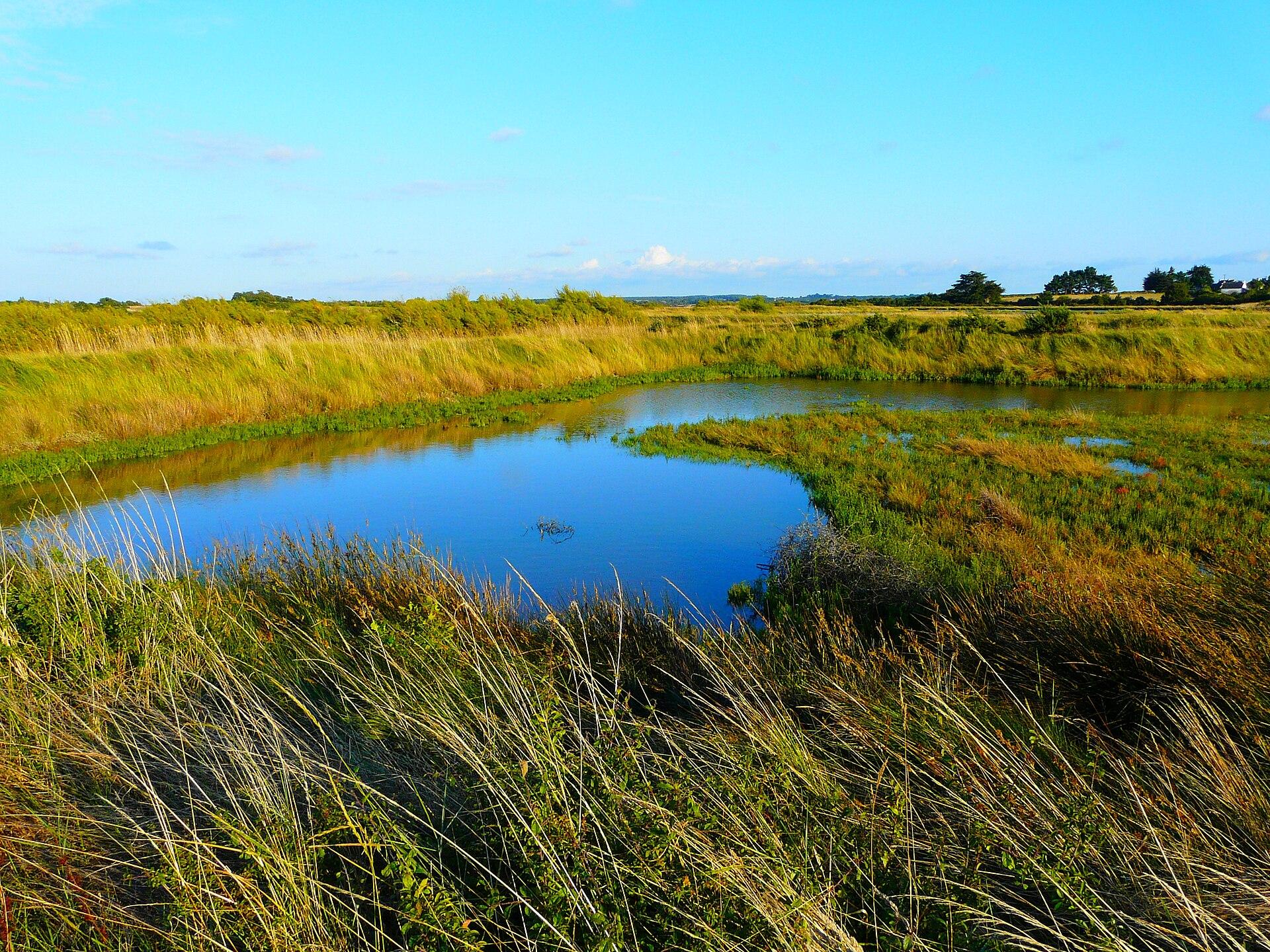
At the far end of the Gulf of Morbihan, 530 hectares of former salt pans, mudflats and meadows where avocets, spoonbills and stilts live. Covered hides, and a free trail open all year.
- Suggested time
- 2 hours per trail, half a day for both
- Type of place
- National nature reserve, marshes and former salt pans
- Atmosphere
- Calm and contemplative, set to the rhythm of the tides and passing birds, under a big open sky
- Getting there
- Centre Nature Rémy Basque, route de Brouel, Séné, a few minutes from Vannes. Parking nearby, daytime only (no overnight stays in motorhomes or vans). By train: Vannes station, then the Kicéo bus network to Séné (check the route to Brouel). By bike from Vannes: the centre has the Accueil Vélo label, but the visit is on foot. The free trail starts about 2 km from the Centre Nature.
Who this place suits
- With family
- 9/10
- As a couple
- 9/10
- With friends
- 8/10
- Solo
- 10/10
- With a dog
- 1/10
- Reduced mobility
- 8/10
These scores are calculated from what the page records: official rating, facilities, difficulty, duration and location. They are a guide, not a substitute for contacting the venue, especially about accessibility.
About
The Séné marshes national nature reserve lies at the far end of the Gulf of Morbihan, on the west bank of the Noyalo river, a few kilometres from Vannes. Designated on 21 August 1996, it protects 410 hectares, and 530 with the buffer zone added in 2002: the largest protected natural area of its kind in the heart of the gulf. It celebrated its 30th anniversary in 2026. The landscape is flat and open: mudflats, salt meadows, channels, former salt pans, wet meadows, heathland, hedges and around fifty ponds. This far corner of the gulf, sheltered from the currents, lets very fine mud settle, one of the richest habitats on the coast: worms, small shellfish and crustaceans abound. At low tide, birds come to feed; when the sea rises and covers the mudflats, many move back to the reserve’s pools, closer to the hides. Just above, the salt meadows, covered only at the highest tides, host glasswort, sea purslane and sea lavender, plants that tolerate salt. This landscape is largely man-made. In 1720, Louis XV granted the clergy of Vannes land covered by the sea to create salt works; salt was produced from 1749, in pools where sun and wind evaporate the water. Facing competition from other regions, the activity declined in the 19th century and disappeared around the middle of the 20th century. The fifty or so abandoned pools have become lagoons, whose water level the reserve team now sets to the centimetre, depending on the birds it wants to attract. Around 220 bird species have been recorded here, 76 of which breed regularly. The pied avocet, with its upturned bill, is its emblem, followed by the black-winged stilt, the spoonbill, the shelduck and the bluethroat. The species change with the seasons: nests and chicks in spring, big migrations at the end of summer, and thousands of ducks and waders from October to March. The reserve is also home to about half of Brittany’s butterfly species, some forty species of dragonflies and ten of amphibians. The protection grew out of the efforts of naturalists. After the Amoco Cadiz oil spill in 1978, donations collected by the association that would become Bretagne Vivante made it possible to buy 14 hectares of salt pans in 1979, the first association-run reserve. The national reserve is now managed by the town of Séné, Bretagne Vivante and the local hunting association. You explore it from the Centre Nature Rémy Basque, named after its first volunteer warden, on two trails: one with facilities and six hides, the other open free all year.
What you will see
- The largest nature reserve in the Gulf of Morbihan: 410 hectares designated, 530 with the buffer zone.
- Around 220 bird species recorded, including the pied avocet, black-winged stilt, spoonbill and shelduck.
- Six covered hides on the main trail, right by the pools, with identification panels and guides.
- A 4.5 km free trail, open all year, with one hide and two platforms.
- Former 18th-century salt pans turned into lagoons: about fifty pools and the remains of a salt store.
- Mudflats and salt meadows of the Noyalo river, where the birds follow the rhythm of the tides.
Show 4 more pointsHide
- About half of Brittany’s butterfly species, dozens of dragonflies and around fifty ponds.
- A trail and two hides accessible by wheelchair, and an easy-read booklet.
- Nature outings all year, activities from age 3, volunteer work days and an international photo competition.
- Binocular hire for €2 and QR codes showing recently seen birds.
Practical information
- Address
- Centre Nature Rémy Basque, route de Brouel, 56860 Séné
- Public transport
- Vannes station, then the Kicéo bus to Séné.
- Parking
- Parking near the Centre Nature, during the day. Overnight parking for motorhomes and vans is banned.
- Pets
- Pet dogs banned from the reserve (1996 decree). Guide dogs accepted on the adapted trail.
- Accessibility
- A trail and two hides accessible by wheelchair (a small step of about 3 cm at the start of the trail), 45 minutes to 1 hour. Easy-read booklet. Guide dogs accepted on the adapted trail.
- Best time
- April to June for a first visit (full trail, nesting). Autumn and winter for migrants and wintering birds.
Tips on the spot
- Pet dogs are banned from the reserve, even on a lead: do not bring yours. Guide dogs are accepted on the adapted trail; let the reserve know in advance.
- The paid visit is closed until 31 January 2027. The red trail stays free every day, and the yellow trail opens free on Sundays from 2 pm to 5 pm.
- 2026 hours for the paid section: February and March 2 pm to 6 pm, April to June 2 pm to 7 pm, closed on Mondays; July and August every day 10 am to 1 pm and 2 pm to 7 pm. The ticket office closes 2 hours earlier (4 pm or 5 pm).
- 2026 prices: €7, reduced €3.50, family €16, free under 7 with family and for Bretagne Vivante members. Binocular hire €2.
- For a first visit, choose the main trail: 4 km, six hides, about 2 hours. Stop for several minutes in each hide: the birds appear little by little.
Show 8 more tipsHide
- Check the tide times: on a rising tide, birds leave the mudflats for the pools, closer to the hides. Also ask at reception what has been seen that day.
- Spring for nests, avocets and stilts; late summer for migrants; October to March for the thousands of wintering ducks and waders.
- Stay on the paths and in the hides, pick nothing and speak quietly: never approach a bird.
- Boating is banned in the reserve (kayak, paddleboard, boat), as are camping, bivouacking, fires and, in principle, fishing.
- Drones: the reserve’s decree bans flights by motorised aircraft below 300 m. Do not fly a drone without permission.
- In winter, on the free trail, wear boots or walking shoes: the paths are wet or muddy.
- With children, turn the visit into a game: find a bird with long pink legs, a curved bill, an all-white bird. Activities are offered from age 3.
- Photographers: a 200 to 600 mm telephoto lens is ideal, but the hides already allow good photos with a smartphone.
Frequently asked questions
How big is it?
410 hectares have been a national nature reserve since 21 August 1996. With the 120-hectare buffer zone added in 2002, 530 hectares are protected.
Do you have to pay?
The main trail, with its six hides, is paid in season: €7 in 2026, €3.50 reduced, €16 for a family, free under 7 with family. The 4.5 km free trail is free all year.
Is the reserve open at the moment?
The paid visit is closed until 31 January 2027. The red trail stays open free of charge every day, and the yellow trail opens free on Sundays from 2 pm to 5 pm thanks to the Amis de la Réserve. Nature outings continue.
What are the opening hours of the paid section?
In 2026: in February and March, 2 pm to 6 pm; from April to June, 2 pm to 7 pm, every day except Monday; in July and August, every day from 10 am to 1 pm and from 2 pm to 7 pm. The ticket office closes two hours before closing time.
Which trail should I choose?
For a first visit, the main trail: about 4 km, six covered hides, identification panels and guides, in 2 hours. The free trail, 4.5 km with one hide and two platforms, is more like a walk. Enthusiasts do both.
Which birds can you see?
Around 220 species have been recorded, 76 of which breed regularly. The most emblematic are the pied avocet, black-winged stilt, spoonbill, shelduck, pintail, black-tailed godwit and bluethroat. The species present change every day.
See also all the nature in Brittany.
Stay in Séné
Places to stay that are still available, with current prices, compared across the main booking platforms.
Partner link: a booking made from this map may earn us a commission, at no extra cost to you.
Read in the journal
- Winter holidaysWhat to do in Morbihan during the February holidaysThe Carnac menhirs in peace, the wild coast of Quiberon, the Gulf of Morbihan in winter and Suscinio: our ideas for the February 2027 holidays in Morbihan.
- ChristmasWhat to do in Morbihan during the Christmas holidaysChristmas in Vannes, the Pont-Scorff light trail, Rochefort-en-Terre lit up and Carnac in winter: our ideas for the 2026 Christmas holidays in Morbihan.
- SeasonWhat to do in Morbihan during the All Saints’ holidaysThe Carnac alignments open to walk among, the Gulf of Morbihan, castles, the wild coast and Lorient: our ideas for All Saints’ 2026 in Morbihan.
Traveller reviews
Nobody has reviewed this place yet.
Photograph: Réserve Naturelle des Marais de Séné · CC BY-SA 4.0 · Wikimedia Commons