Heritage site
Morlaix and its viaduct
Morlaix · Finistère
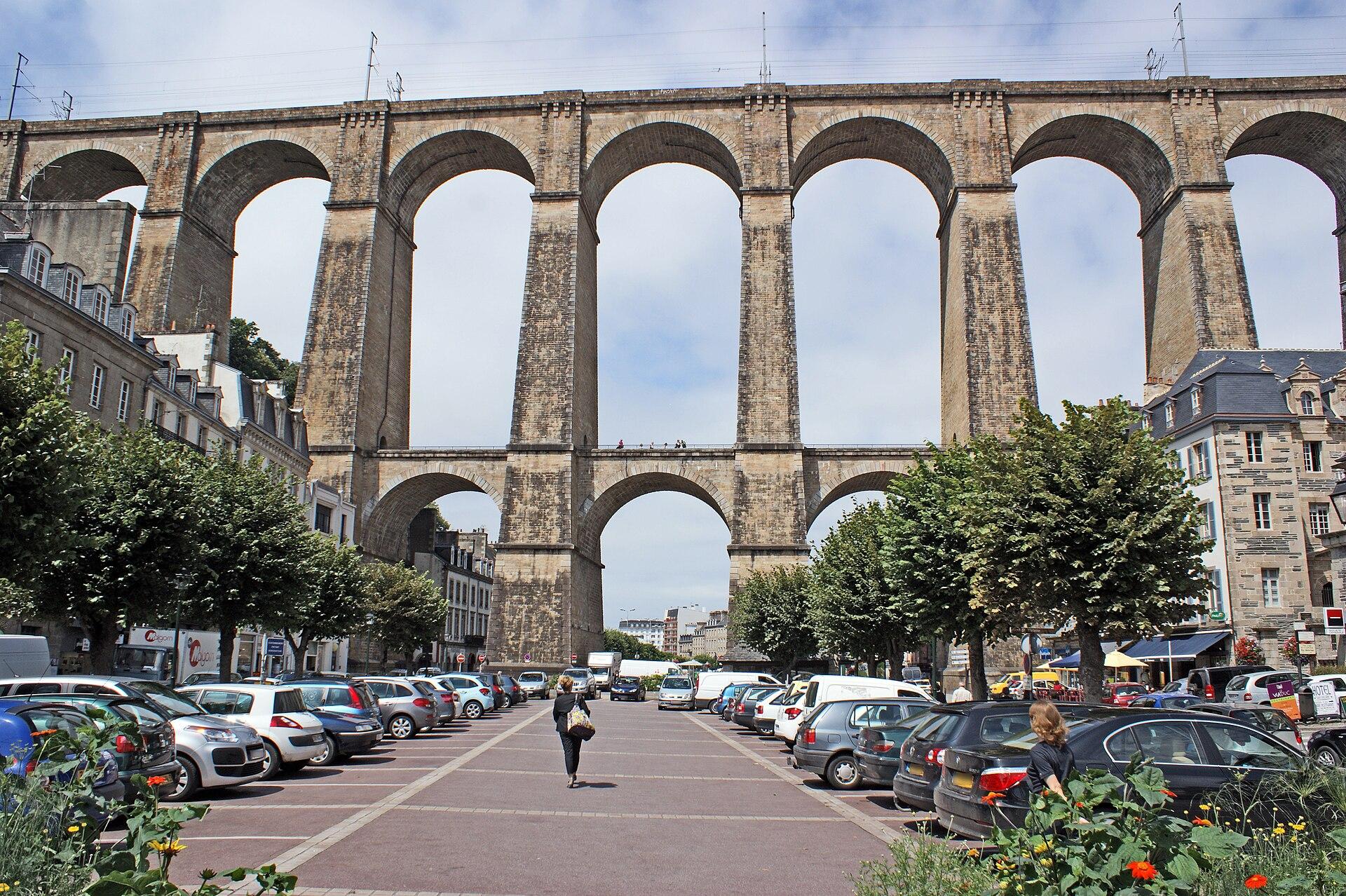
A merchant town at the bottom of a valley, overlooked by a 284-metre railway viaduct whose lower level you can cross on foot.
- Suggested time
- Half a day
- Type of place
- Historic town and railway viaduct
- Atmosphere
- Urban, vertical and mercantile
- Getting there
- The centre is on foot, but the town is very hilly: steps and steep climbs between the valley floor and the hills
Who this place suits
- With family
- 8/10
- As a couple
- 9/10
- With friends
- 8/10
- Solo
- 9/10
- With a dog
- 7/10
- Reduced mobility
- 4/10
These scores are calculated from what the page records: official rating, facilities, difficulty, duration and location. They are a guide, not a substitute for contacting the venue, especially about accessibility.
About
Morlaix comes down to one unforgettable image: a two-tier stone viaduct of arches set right across the town centre, with trains passing above the rooftops. It is no relic. Built from 1861 to 1863 to carry the Paris-Brest line over a valley too deep to go down and back up, it still carries trains from Paris, Rennes and Brest today. The French Ministry of Culture gives it a length of 284 metres and a height of 59 metres, with fourteen large arches on the upper level and nine on the lower level. And that lower level, designed from the start to link the two sides of the valley, can be crossed on foot, free of charge, as the Promenade de Guichen. The town explains the viaduct. Morlaix grew up at the bottom of a very deep valley, where the Jarlot and the Queffleuth meet to form the Morlaix river, which reaches the Channel some twelve kilometres further on. The historic centre fills the valley floor, while the old suburbs climb three hills. Everything follows from this: steep streets, steps, lanes, terraced gardens known here as kombots, and viewpoints at every turn. In Morlaix, three kilometres on foot are not a three-kilometre stroll. Behind the viaduct lies a much older town, far richer than you might expect. The harbour, at the head of the ria, let ships sail right into the heart of the town. In the 15th and 16th centuries, Morlaix exported crées, fine linen cloth from the Léon grown, spun, woven and bleached throughout the hinterland, to England, the Netherlands, Spain and Portugal. The town was then one of Brittany’s great ports. Its merchants grew rich, and they built. This fortune left an architecture found almost nowhere else: the pondalez houses. On a narrow, deep plot, they were built upwards around a huge central space lit from above, the lantern. A wooden spiral staircase climbs several floors, and wooden walkways, the pondalez, link it to the rooms across the void. The house at 9 Grand Rue and the so-called House of Duchess Anne, on Rue du Mur, let you understand this system from the inside. With about 152 half-timbered houses, Morlaix has the highest concentration in Finistère. The viaduct also carries the town’s heaviest memory. On 29 January 1943, twelve Royal Air Force bombers came to destroy it to cut the railway link to the German submarine base in Brest. The viaduct held: one arch was damaged and traffic soon resumed. But the bombs fell on the town. The town of Morlaix records sixty-seven dead, including thirty-nine children from the Notre-Dame-de-Lourdes school, aged four to seven, and their teacher. The Notre-Dame-des-Anges chapel was built where the tragedy happened. Lower down, Place des Otages recalls the reprisals of December 1943 and the people of Morlaix who were deported. You pass under these arches as a tourist; it is right to know what they have seen.
What you will see
- A 284-metre railway viaduct, 59 metres high, set right across the town centre
- Its lower level can be crossed on foot for free: the Promenade de Guichen
- A structure still in service, used every day by Paris-Rennes-Brest trains
- Fourteen large arches on the upper level, nine on the lower level
- About 152 half-timbered houses, the highest concentration in Finistère
- The pondalez houses, an interior architecture unique to Morlaix: lantern, spiral staircase, walkways
Show 4 more pointsHide
- A town built at the bottom of a valley between three hills, with lanes, steps and terraced gardens
- The harbour at the head of the ria, source of the fortune made from Léon linen
- The 1736 Tobacco Factory, an industrial palace turned cultural quarter
- A historic centre you can explore almost entirely for free
Practical information
- Address
- Centre historique, 29600 Morlaix
- Public transport
- Morlaix station is on the Paris-Rennes-Brest line, served by TGV trains: about 3 hours from Paris, 1 hour 35 from Rennes and 30 minutes from Brest for the fastest journeys. The station is above the centre: going down is easy, coming back up much less so, and a free electric shuttle links the station and the town centre.
- Parking
- Paid parking and blue zones in the town centre, with the first half hour free in paid areas. There are many free spaces around the centre, notably towards the harbour, Quai du Léon, Quai de Tréguier and several outlying squares. For a visit of several hours, it is best to park a little out of the centre and walk up. Check the rules on site.
- Pets
- Exploring outdoors works very well with a dog, on a lead in town. Access to monuments and museums varies from site to site: check before each indoor visit.
- Accessibility
- Difficult overall: the town is built in a valley, and the hills and steps make it a demanding destination. The lower town remains manageable: the harbour, Place des Otages, the Maison Penanault and the central streets. Most lanes cannot be used in a wheelchair, and access to the viaduct from the centre involves slopes or steps. Call the tourist office for an adapted route.
- Best time
- Spring and September for the light and long days. Morning for quiet streets, late afternoon for the views from the heights.
Tips on the spot
- Start with the Maison Penanault: the interpretation centre is free and gives you the key to the town before you explore
- Allow half a day for a proper first visit, two hours for the essentials
- Climb to the lower level of the viaduct by the Venelle de la Roche or the Venelle aux Prêtres
- The upper level is a working railway line: never try to get onto it
- Wear good shoes: the hills and steps give the town all its character, and all its fatigue
Show 7 more tipsHide
- In the rain, cobbles and steps become slippery: go down the lanes carefully
- The Esplanade du Calvaire offers one of the best free views over the harbour and the viaduct
- With a pushchair, stay in the lower town and around the harbour; a baby carrier is better for the lanes
- The market is held on Saturday mornings in the centre: combine it with your visit, accepting bigger crowds
- Park a little outside the centre and explore on foot: there are several free areas around the heart of town
- By train, the station is above the centre: going down is easy, coming back up less so, and a free shuttle links the two
- The Jacobins site is closed for works: the museum’s collections can still be seen elsewhere
Frequently asked questions
Why is Morlaix called the city of the viaduct?
Because the structure crosses and towers over the historic heart. You can see it from almost everywhere in the centre.
When was the viaduct built?
From 1861 to 1863, for the Paris-Brest line. The line opened in 1865.
Why was a viaduct needed?
Because the valley is too deep. The line would have had to drop steeply and climb back up: it was better to cross high above it.
Who designed it?
The engineers Victor Fénoux and Planchat.
How big is it?
The French Ministry of Culture gives 284 metres long and 59 metres high.
Why do you also see 292 metres, or 58 or 62 metres high?
The figures depend on where the measurement starts: the valley floor, street level or the riverbed.
See also all the heritage in Brittany.
Stay in Morlaix
Places to stay that are still available, with current prices, compared across the main booking platforms.
Partner link: a booking made from this map may earn us a commission, at no extra cost to you.
Read in the journal
- ChristmasWhat to do in Finistère during the Christmas holidaysChristmas at Trévarez, the Quimper Christmas village, Locronan lit up, Océanopolis and wild headlands: our ideas for the 2026 Christmas holidays in Finistère.
- SeasonWhat to do in Finistère during the All Saints’ holidaysThe Pointe du Raz, Océanopolis, the Huelgoat forest, spring tides and the legends of the Monts d’Arrée: our ideas for All Saints’ 2026 in Finistère.
- RankingThe most beautiful beaches in FinistèreLa Torche, the Baie des Trépassés, Les Blancs Sablons, Morgat, Raguénez and the white sand of Léon: our selection of the most beautiful beaches in Finistère, for everyone.
Traveller reviews
Nobody has reviewed this place yet.
Photograph: Bruno Corpet (Quoique) · CC BY-SA 3.0 · Wikimedia Commons