Lighthouse
Créac’h Lighthouse
Ouessant · Finistère
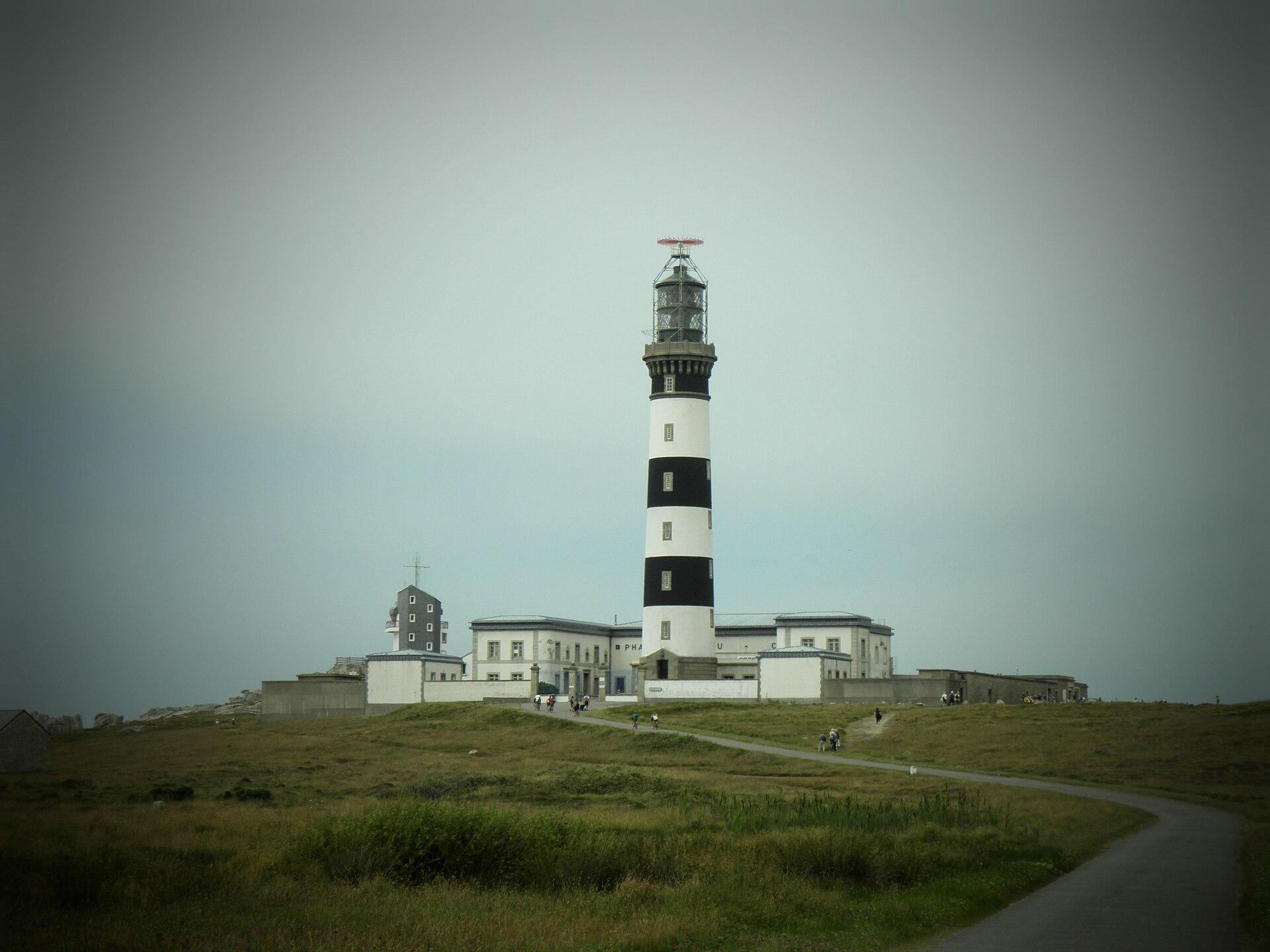
Ouessant’s 54.85 m black and white tower, two flashes every 10 seconds, a range of about 30 nautical miles and one of the most remarkable optics in Europe.
- Suggested time
- 1 to 2 hours in the area, as part of a full day on Ouessant
- Type of place
- Major active lighthouse, listed as a historic monument
- Atmosphere
- Oceanic, powerful, technical and iconic
- Getting there
- Western tip of Ouessant. On foot, by bike or with island transport. The tower cannot be visited. The Lighthouse and Beacon Museum is currently closed for renovation.
Who this place suits
- With family
- 7/10
- As a couple
- 9/10
- With friends
- 8/10
- Solo
- 9/10
- With a dog
- 7/10
- Reduced mobility
- 7/10
These scores are calculated from what the page records: official rating, facilities, difficulty, duration and location. They are a guide, not a substitute for contacting the venue, especially about accessibility.
About
Le Créac’h is one of Ouessant’s great visual signatures. Its 54.85 metre tower, painted in wide black and white bands, stands at the western tip of the island facing one of the busiest shipping lanes in Europe. The imperial decree authorising its construction dates from 1860, and the lighthouse was lit on 19 December 1863. It was electrified as early as 1888 and then received several generations of optics and light sources. Its current system relies on four large lenses arranged on two levels, an exceptional layout. The light gives two grouped white flashes every ten seconds, with an announced range of around 30 nautical miles. Le Créac’h has been listed as a historic monument since 2011 and is still active, but the tower is not open to visitors. The former power station at its foot houses the Lighthouse and Beacon Museum. In 2026 it is still being renovated, and the maritime authority (DIRM) is also modernising the optics, notably to remove the mercury bath while preserving the heritage character of the whole. Even without access to the tower and with the museum closed, the site is still major: the wild coast, the Pointe de Pern, the signalling equipment and the light itself show why Ouessant is inseparable from the history of lighthouses.
What you will see
- Visit status: the tower cannot be visited; the museum is closed for renovation in 2026.
- Height: 54.85 m.
- Light: two grouped white flashes every 10 seconds, range about 30 nautical miles.
- Optics: four lenses on two levels, an exceptional layout.
- 1860: imperial decree authorising a second major lighthouse on Ouessant.
- 19 December 1863: the light is switched on; 1888: electrification.
Show 5 more pointsHide
- 1901: the optics are strengthened; 1938 to 1939: a new lantern and monumental optics.
- 1969: xenon arc lamps; 1995: replaced by metal halide lamps.
- 2005: partly listed; 23 May 2011: listed as a historic monument.
- 2026: modernisation project, notably to remove the mercury from the rotation system.
- Families: a very good site for a day on Ouessant, even without visiting the tower.
Practical information
- Getting there
- Western tip of Ouessant, on foot, by bike or with island transport
- Pets
- Check the rules for the ferry, shuttles and natural areas
- Accessibility
- Outdoor access to the area depends on island transport and paths. The tower cannot be visited.
- Safety
- The Ouessant coast is exposed to wind and swell; stay on the paths and keep away from the cliffs in storms
- Best time
- Morning or late afternoon, in clear weather.
- Photography
- The black and white bands make for graphic images; the wild coast, stone walls and changing light of Ouessant vary the shots
- Nearby
- The Pointe de Pern, Nividic, the Ouessant ecomuseum, Lampaul, the Stiff lighthouse, the wild coast of Ouessant
Tips on the spot
- Check the visit status on the day before you travel, and do not confuse access to the site, the foot of the lighthouse and the inside of the tower.
- For a lighthouse open to visitors, check the time of the last climb, not just the closing time.
- For a lighthouse at sea, only watch it from a boat run by a professional or from a safe viewpoint on land.
- Bring a windproof layer, even in summer; stairs and galleries can be slippery with rain or spray.
- With children, check the number of steps and any minimum age; with vertigo, the climb to the gallery is not for everyone.
Show 7 more tipsHide
- Working lighthouses are maritime safety equipment: respect all restricted technical areas.
- For photos, use a wide angle at the foot of the lighthouse and a telephoto lens for lighthouses seen from a distance.
- On an island, check the last boat back before starting the visit.
- On cliffs, stay behind the barriers and on the paths; keep dogs on a lead in nature reserves.
- Visits can be cancelled at the last minute for safety reasons.
- Allow 1 to 2 hours in the area, as part of a full day on Ouessant.
- Combine it with the Pointe de Pern and the Nividic lighthouse.
Frequently asked questions
Can you visit Créac’h Lighthouse?
The tower cannot be visited, and the museum is closed for renovation in 2026. The site at the western tip of Ouessant is open on foot or by bike.
How much time should I allow?
1 to 2 hours in the area, as part of a full day on Ouessant.
What makes the site special?
It is one of Europe’s most iconic lighthouses, and it shows Ouessant’s role in guiding ships into the Channel.
What is the atmosphere like?
Oceanic, powerful, technical and iconic.
When is the best time for photos?
The black and white bands make for graphic images; morning or late afternoon light varies the shots.
Is there any particular risk?
The Ouessant coast is exposed to wind and swell. Stay on the paths and keep away from the cliffs in storms.
See also the lighthouses in Ouessant.
Stay in Ouessant
Places to stay that are still available, with current prices, compared across the main booking platforms.
Partner link: a booking made from this map may earn us a commission, at no extra cost to you.
Read in the journal
- DepartmentWhat to do in FinistèreThe tip of Brittany, from the Pays des Abers to the Bay of Concarneau: lighthouses, coves and towns of character.
- ChristmasWhat to do in Finistère during the Christmas holidaysChristmas at Trévarez, the Quimper Christmas village, Locronan lit up, Océanopolis and wild headlands: our ideas for the 2026 Christmas holidays in Finistère.
- SeasonWhat to do in Finistère during the All Saints’ holidaysThe Pointe du Raz, Océanopolis, the Huelgoat forest, spring tides and the legends of the Monts d’Arrée: our ideas for All Saints’ 2026 in Finistère.
Traveller reviews
Nobody has reviewed this place yet.
Photograph: Gzen92 · CC BY-SA 4.0 · Wikimedia Commons