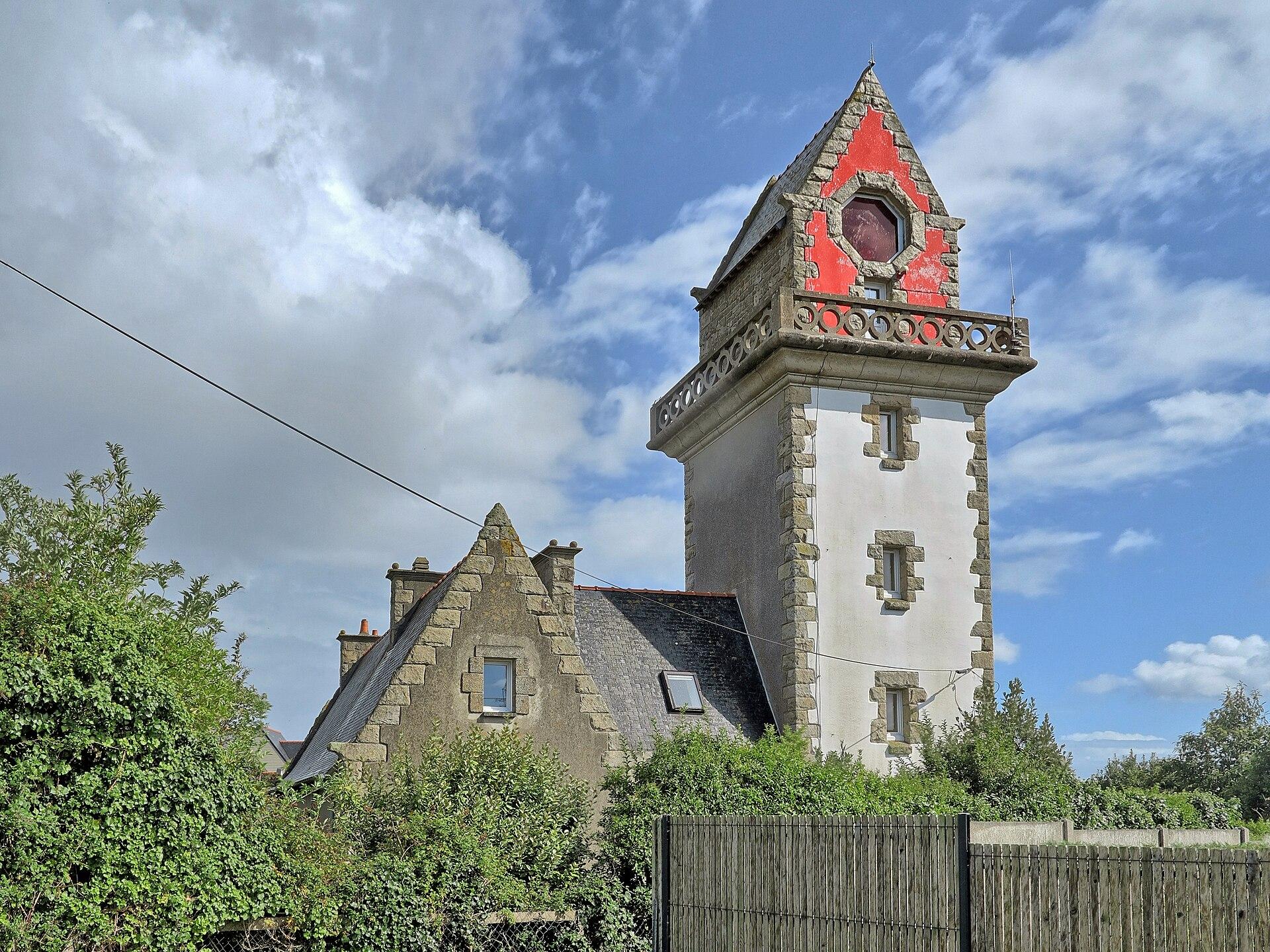
Lighthouse
Rochebonne Lighthouse
Saint-Malo / Paramé · Ille-et-Vilaine
In Paramé, this 19.90 m square tower carries a red directional light visible 24 miles away and, with the Grand Jardin, forms the Grande Porte leading line into Saint-Malo.
- Suggested time
- 30 minutes to 1 hour, more if you continue to Rochebonne beach, Paramé or other Saint-Malo lighthouses
- Type of place
- Onshore leading light
- Atmosphere
- Urban, maritime, technical and discreet
- Getting there
- The lighthouse stands in the Rochebonne and Paramé area of Saint-Malo. It can be seen from public spaces. There are no regular tourist visits of the tower.
Who this place suits
- With family
- 7/10
- As a couple
- 8/10
- With friends
- 8/10
- Solo
- 9/10
- With a dog
- 7/10
- Reduced mobility
- 7/10
These scores are calculated from what the page records: official rating, facilities, difficulty, duration and location. They are a guide, not a substitute for contacting the venue, especially about accessibility.
About
The Rochebonne lighthouse is a fine example of a lighthouse whose interest becomes clear once you understand its role. Standing in Paramé, back from the shore and on high ground, it has neither the dramatic position of an offshore lighthouse nor the scale of the great Iroise towers. Yet its red directional light plays a key role in the approach to Saint-Malo. With the Grand Jardin lighthouse, Rochebonne marks the leading line of the Grande Porte channel. The current tower, 19.90 metres high, carries its light 45.80 metres above the sea. The first lighthouse was started in June 1866 and finished in December 1867. Electrified in 1929, it was destroyed in 1944 and rebuilt in its current form in 1948. The new light was lit in September 1951 and automation came in 1975, ending the keepers’ service. Today, the lighthouse is remote-controlled from the Saint-Malo lighthouse service office. The best way to discover it is to see it as part of the much wider system of Saint-Malo lights: the Grand Jardin, La Balue and Les Bas-Sablons. Rochebonne then becomes not just a tower in town, but one part of a very precise navigation system.
What you will see
- Site type: onshore leading light.
- Visits: closed to visitors.
- Height: 19.90 m.
- Elevation: 45.80 m above the sea.
- Light: a fixed red directional light.
- Range: 24 miles.
Show 14 more pointsHide
- Optics: directional optics, 0.50 m focal length.
- Lamp: 70 W.
- Automation: 1975.
- Remote control: from the Saint-Malo lighthouse service office.
- June 1866: construction of the first lighthouse begins.
- December 1867: the first tower, in exposed rubble stone, is finished.
- 1929: the lighthouse is electrified, after a period of paraffin lighting.
- 1944: the lighthouse is destroyed during the Second World War.
- 1948: rebuilt in its current form.
- September 1951: the new lighthouse is lit.
- 1975: automation and the end of the keeper’s post.
- 10 February 2000: the Sylédis radio navigation station in the lighthouse is removed.
- With children: easy for a short stop, especially combined with the beach and a seafront walk.
- Combine with: Rochebonne beach, Paramé, Saint-Malo Intra-Muros, and the Grand Jardin, La Balue and Les Bas-Sablons lighthouses.
Practical information
- Accessibility
- It can be seen from outside in town, but there is no adapted indoor visit.
- Best time
- Morning or late afternoon, in clear weather.
- Photography
- The best views show the lighthouse in its urban setting or link it to the bay; a telephoto lens isolates the top and the white, grey and red contrast
Tips on the spot
- Check the visit status on the day before you travel, and do not confuse access to the site, the foot of the lighthouse and the inside of the tower.
- For a lighthouse open to visitors, check the time of the last climb, not just the closing time.
- For a lighthouse at sea, only watch it from a boat run by a professional or from a safe viewpoint on land.
- Bring a windproof layer, even in summer; stairs and galleries can be slippery with rain or spray.
- With children, check the number of steps and any minimum age; with vertigo, the climb to the gallery is not for everyone.
Show 7 more tipsHide
- Working lighthouses are maritime safety equipment: respect all restricted technical areas.
- For photos, use a wide angle at the foot of the lighthouse and a telephoto lens for lighthouses seen from a distance.
- On an island, check the last boat back before starting the visit.
- On cliffs, stay behind the barriers and on the paths; keep dogs on a lead in nature reserves.
- Visits can be cancelled at the last minute for safety reasons.
- Look out to sea towards the Grand Jardin to picture the Grande Porte leading line.
- Bring binoculars to see the architectural details without leaving the permitted areas.
Frequently asked questions
Can I visit the Rochebonne lighthouse?
No. It stands in the Rochebonne and Paramé area of Saint-Malo and can be seen from public spaces; there are no regular tourist visits of the tower.
How much time should I allow?
30 minutes to 1 hour, more if you continue to Rochebonne beach, Paramé or other Saint-Malo lighthouses.
What is the main interest of the site?
Understanding, from land, the very precise leading lines that make the sea approach to Saint-Malo safe.
What is the atmosphere like?
Urban, maritime, technical and discreet.
How can I take good photos?
Show the lighthouse in its urban setting or link it to the bay; a telephoto lens isolates the top and the white, grey and red contrast.
Is there any particular risk?
No particular difficulty when viewing from public spaces. Do not try to enter the technical enclosure.
Stay in Saint-Malo / Paramé
Places to stay that are still available, with current prices, compared across the main booking platforms.
Partner link: a booking made from this map may earn us a commission, at no extra cost to you.
Read in the journal
- ChristmasWhat to do in Ille-et-Vilaine during the Christmas holidaysThe Rennes Christmas markets, Saint-Malo in winter, Cancale oysters, Vitré and Fougères: our ideas for the 2026 Christmas holidays in Ille-et-Vilaine.
- SeasonWhat to do in Ille-et-Vilaine during the All Saints’ holidaysThe Route du Rhum in Saint-Malo, Brocéliande for Samain, castles, the Lices market and Cancale oysters: our ideas for All Saints’ 2026 in Ille-et-Vilaine.
- RankingThe most beautiful beaches in Ille-et-VilaineThe Sillon and Bon-Secours in Saint-Malo, L’Écluse in Dinard, Longchamp, Saint-Briac and Cancale: the most beautiful beaches in Ille-et-Vilaine, on the Emerald Coast.
Traveller reviews
Nobody has reviewed this place yet.
Photograph: JGS25 · CC BY-SA 4.0 · Wikimedia Commons