Natural site
Jardin Exotique de Roscoff
Roscoff · Finistère
More than 3,500 plants from the southern hemisphere on 1.6 hectares facing the bay of Morlaix: proteas, aloes, agaves, tree ferns and an 18 m rock to climb for the view.
- Suggested time
- 1 h 15 on average, 2 hours for enthusiasts
- Type of place
- Exotic botanical garden, Jardin remarquable
- Atmosphere
- Lush and exotic, between dry rock gardens and damp corners, with the sea as a backdrop
- Getting there
- 130 route de Traon Erc’h, Roscoff, near the Bloscon harbour: follow signs for the car ferry, then the blue “Jardin Exotique” signs. Small car park on site; if it is full, park at the stadium or at the Bloscon marina, 5 minutes on foot. From the centre of Roscoff: 25 to 30 minutes on foot along the GR 34, or by bike on the route marked in green. In summer, the Roskobus shuttle stops at the stadium.
Who this place suits
- With family
- 9/10
- As a couple
- 9/10
- With friends
- 8/10
- Solo
- 9/10
- With a dog
- 9/10
- Reduced mobility
- 6/10
These scores are calculated from what the page records: official rating, facilities, difficulty, duration and location. They are a guide, not a substitute for contacting the venue, especially about accessibility.
About
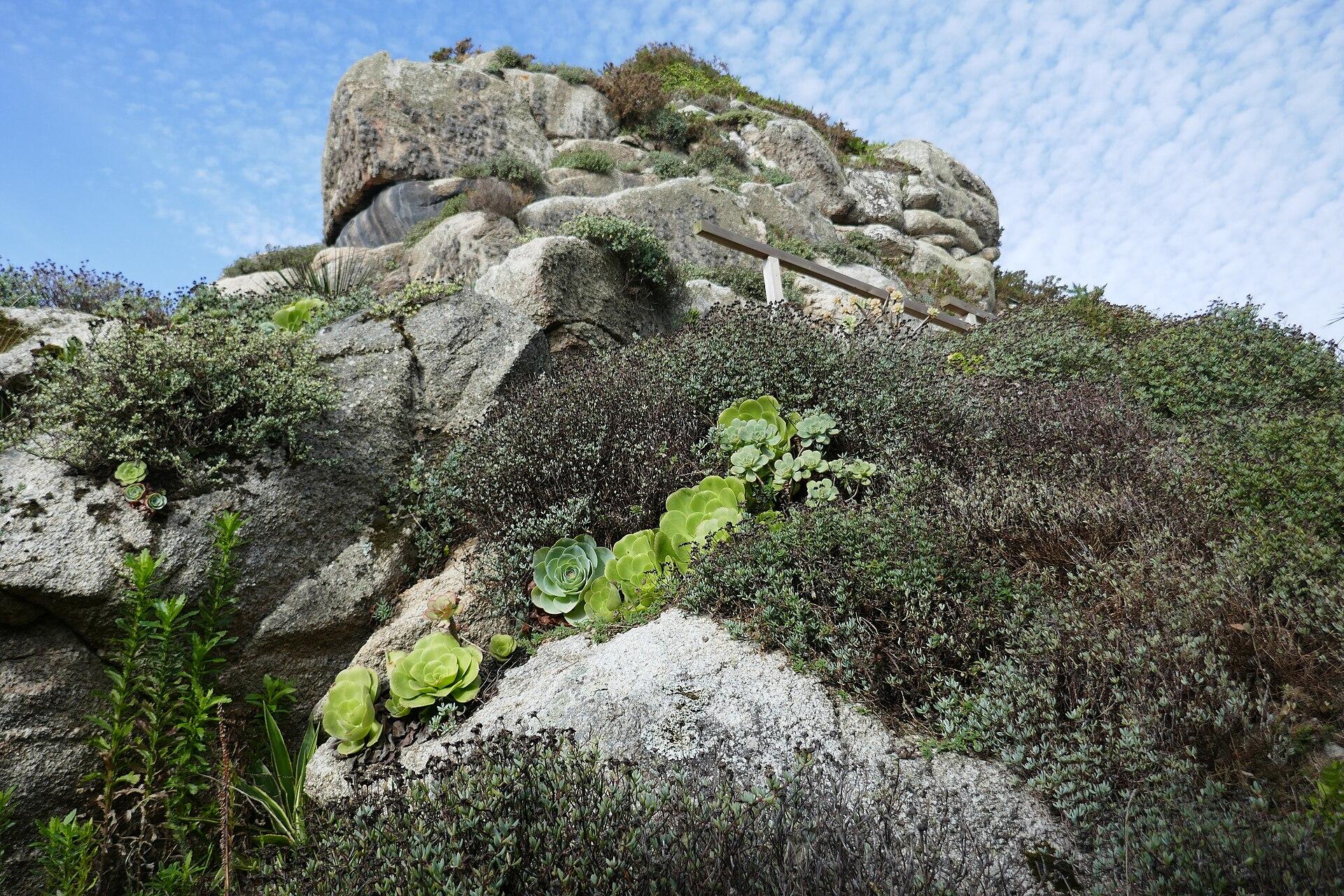
On barely 1.6 hectares facing the bay of Morlaix, the Jardin Exotique & Botanique de Roscoff brings together more than 3,500 plant species, mostly from the southern hemisphere: South Africa, Australia, New Zealand, Chile, Mexico, the Canaries and Madeira. Proteas, aloes, agaves, banksias and tree ferns grow in open ground, beside the Channel. The paths wind, climb and hide behind hedges: you never see the whole garden at once, and it feels much bigger than it is. The secret lies in the climate more than the heat. Almost surrounded by the sea, the Roscoff coast has mild summers but very little frost: according to the garden, it usually does not freeze at the foot of the rock, and rarely drops below -5 °C in the upper part. The granite of Roc’h Hievec stores the heat of the day and releases it at night, while blocking the east wind; hedges divide the rest of the garden into small sheltered rooms. The plants are not arranged by continent but by their needs for sun, water and shelter, to create a landscape that looks natural. It all began in 1986, when the Département bought the Roc’h Hievec rock to protect it. Louis Kerdilès, the town gardener, cleared it and made the first plantings; Daniel Person, a protea enthusiast, pushed for a real collection. The GRAPES association was founded in 1987, later sponsored by the Jardin Exotique de Monaco, and still runs the garden. Other plots were added in the 1990s, and admission became paid in 1995, with professional gardeners joining the volunteers. It is also a garden for acclimatisation and conservation. New species are tested here every year, and the landscape changes from one season to the next. The Conservatoire des Collections Végétales Spécialisées recognises two National Collections here, South African Protea and Restionaceae, as well as approved collections of Aeonium, Crassula, Echeveria and Melianthus. Some of the plants grown here are threatened, or even extinct, in the wild. A cold greenhouse shelters cacti and succulents, which fear the damp of the Breton winter more than the cold. Awarded the Jardin remarquable label by the Ministry of Culture, the garden was first runner-up for the 2025 Prix de l’Art du Jardin. In the centre, 78 steps lead to the top of the rock, 18 metres high, with a view over the bay of Morlaix and the Bloscon harbour. The route also passes waterfalls and ponds, a scent garden and a southern-hemisphere vegetable garden created in 2017, and ends at the plant nursery, which is free to enter.
What you will see
- More than 3,500 plant species on 1.6 hectares, mostly from the southern hemisphere: South Africa, Australia, Chile, the Canaries.
- Roc’h Hievec, an 18 m rock at the heart of the garden: 78 steps for a view over the bay of Morlaix.
- Two National Collections recognised by the CCVS: South African Protea and Restionaceae.
- Approved collections of Aeonium, Crassula, Echeveria and Melianthus, including plants extinct in the wild.
- Aloes, agaves and succulents in the rock gardens, delicate cacti in a new cold greenhouse opened in July 2025.
- Tree ferns from Oceania, Chilean fire trees, Australian banksias and tall eucalyptus.
Show 4 more pointsHide
- A microclimate with little frost, created by the sea, the rock that releases the day’s heat and the hedges that block the wind.
- Waterfalls, ponds, a scent garden and an experimental southern-hemisphere vegetable garden.
- Jardin remarquable label from the Ministry of Culture, first runner-up for the 2025 Prix de l’Art du Jardin.
- A free plant nursery where you can take home plants grown in the garden.
Practical information
- Address
- 130 route de Traon Erc’h, 29680 Roscoff
- Parking
- Small garden car park; otherwise the stadium or the Bloscon marina, 5 minutes on foot. Roskobus stop at the stadium in summer.
- Pets
- Allowed on a lead.
- Accessibility
- About 60% of the garden is accessible by wheelchair and pushchair. The top of the rock (78 steps) is not. Reduced-mobility price: €3.
- Best time
- April to June for a first visit; March for proteas and banksias; summer and early autumn for succulents.
Tips on the spot
- Open every day, including public holidays, from 5 March to 31 October 2026: 10 am to 6 pm, and 10 am to 7 pm in July and August. Closed from November to February. Last entry about an hour before closing.
- 2026 prices: €7 per adult, €3 for ages 8 to 17 and for people with reduced mobility, €5 for students and jobseekers, free under 8. Family (2 adults and 2 paying children): €20. Card, cash, cheques and Chèques-Vacances accepted.
- In strong winds or storms, the garden may close: the tall eucalyptus can lose branches. Call before you set off (02 98 61 29 19).
- Climb to the top of Roc’h Hievec, but count on 78 steps: it is not wheelchair accessible.
- About 60% of the garden can be used by wheelchairs or pushchairs, with a few detours. The rest has slopes, steps and narrow paths.
Show 7 more tipsHide
- Take time to read the labels and visit the greenhouse: a quick visit takes 45 minutes, but you can easily spend two hours.
- March and April are worth the trip: proteas and banksias flower from the end of winter, and the garden is still quiet. April to June remains the best compromise for a first visit.
- Dogs allowed on a lead, never in the flower beds. Do not pick anything, and only rub the leaves in the scent garden.
- The nursery, near reception, is free to enter: no ticket is needed to buy a plant. Ask about its resistance to frost, wind and damp before planting it at home.
- Small car park: in summer, park directly at the stadium or the Bloscon harbour, 5 minutes away.
- Photos are free for personal use; any commercial use requires the garden’s permission.
- Picnic tables and a baby-changing table on site. For children, an hour is enough: the rock, the cacti and a hunt for the strangest plants.
Frequently asked questions
What are the opening hours in 2026?
From 5 March to 31 October, every day including public holidays: 10 am to 6 pm, and until 7 pm in July and August. Last entry about an hour before closing. The garden is closed from November to February.
How much is admission?
In 2026: €7 per adult, €3 for ages 8 to 17 and for people with reduced mobility, €5 for students and jobseekers, free under 8. The family ticket (2 adults and 2 paying children) costs €20.
How much time should I allow?
About 1 h 15 on average. A quick visit takes 45 minutes; botany or photography enthusiasts can easily spend two hours.
Why do exotic plants grow in Roscoff?
Because there is very little frost. Almost surrounded by the sea, the coast keeps mild winters. In the garden, the Roc’h Hievec rock releases at night the heat stored during the day and blocks the east wind, and the hedges create sheltered corners. It is not the heat that matters, but the lack of hard frost.
How many plants are there?
The garden lists more than 3,500 different species or plants on about 1.6 hectares. A little over a third come from South Africa, a little over a quarter from the Americas, and about a quarter from Australia and New Zealand.
Can you climb the rock?
Yes: 78 steps lead to the top of Roc’h Hievec, about 18 metres high, with a view over the bay of Morlaix and the Bloscon harbour. This part is not wheelchair accessible.
See also all the nature in Brittany.
Stay in Roscoff
Places to stay that are still available, with current prices, compared across the main booking platforms.
Partner link: a booking made from this map may earn us a commission, at no extra cost to you.
Read in the journal
- SeasonWhat to do in Finistère during the All Saints’ holidaysThe Pointe du Raz, Océanopolis, the Huelgoat forest, spring tides and the legends of the Monts d’Arrée: our ideas for All Saints’ 2026 in Finistère.
- Winter holidaysWhat to do in Finistère during the February holidaysOcéanopolis, wave battered headlands, spring tides in the Iroise, Locronan and Huelgoat: our ideas for the February 2027 holidays in Finistère.
- ChristmasWhat to do in Finistère during the Christmas holidaysChristmas at Trévarez, the Quimper Christmas village, Locronan lit up, Océanopolis and wild headlands: our ideas for the 2026 Christmas holidays in Finistère.
Traveller reviews
Nobody has reviewed this place yet.
Photograph: Wilrooij · CC BY-SA 4.0 · Wikimedia Commons