Natural site
Forêt de Brocéliande
Paimpont · Ille-et-Vilaine
Nearly 12,000 hectares around Paimpont, with forests, heathland, lakes and purple schist: the Val sans Retour, the Fontaine de Barenton, Merlin’s Tomb. A mostly private forest, with waymarked trails.
- Suggested time
- 1 day minimum, ideally 2 or 3 days
- Type of place
- Legendary forest, heathland, lakes and megaliths
- Atmosphere
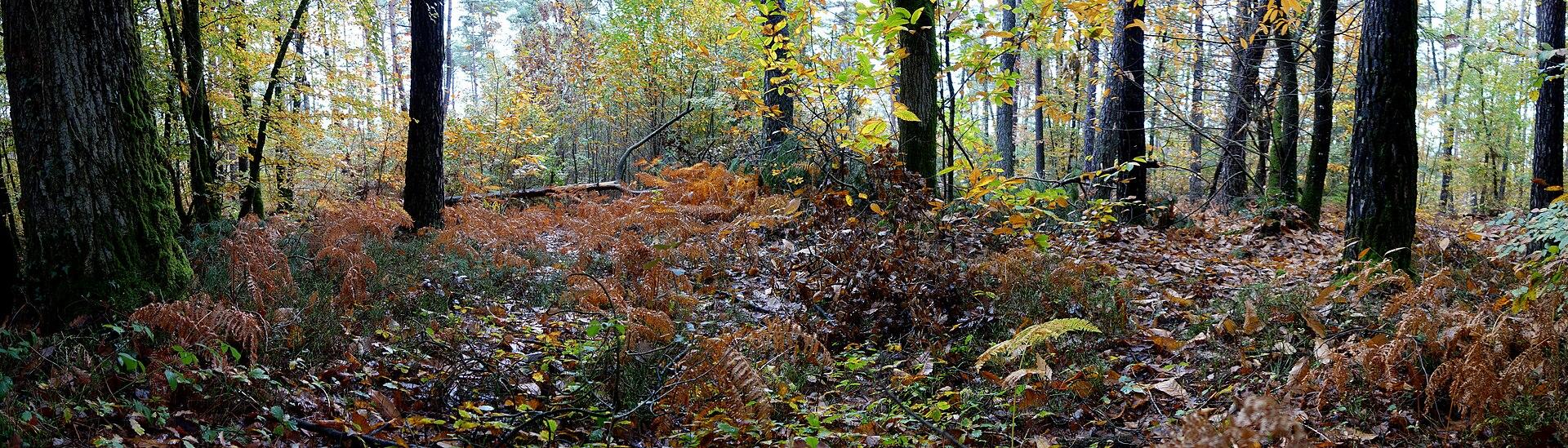
- Mysterious and peaceful, misty in the morning, blazing in autumn, between woodland, heathland and still waters
- Getting there
- Paimpont, about 40 km west of Rennes via the RN24 (exit Plélan-le-Grand / Paimpont). There is no single entrance: put a precise place in your GPS (Paimpont, Tréhorenteuc for the Val sans Retour, Fontaine de Barenton, Tombeau de Merlin, Château de Comper). The sites are far apart: about 7 km from Paimpont to Concoret, 14 km to Tréhorenteuc. Without a car, BreizhGo line 500 links Rennes to Paimpont in about 1 h 05 (2026), then electric bike, taxi or an organised tour. The natural sites are free.
Who this place suits
- With family
- 10/10
- As a couple
- 10/10
- With friends
- 9/10
- Solo
- 9/10
- With a dog
- 8/10
- Reduced mobility
- 6/10
These scores are calculated from what the page records: official rating, facilities, difficulty, duration and location. They are a guide, not a substitute for contacting the venue, especially about accessibility.
About
The Brocéliande forest is first of all a very real forest: the Paimpont massif, some forty kilometres west of Rennes, straddling Ille-et-Vilaine and Morbihan. It is the largest forest in Brittany, nearly 12,000 hectares according to the tourist office. Paimpont is its name on maps; Brocéliande is the name of the forest in medieval romances, identified with this massif over the centuries and now its tourist name. It is not a public forest where you can walk anywhere. The massif is overwhelmingly private: you enter it by the waymarked trails the owners open to the public, and only the Gaël-Paimpont state forest, about 557 hectares managed by the ONF (national forestry office), belongs to the State. To the south, the Saint-Cyr Coëtquidan military camp covers more than 5,000 hectares closed to the public. From 15 September to 31 March, hunting and logging close or divert some of the paths. The landscape is far more varied than a stand of tall trees: oak and beech woods, conifers, heather and gorse heathland on the poor soils of the west, peat bogs, streams and a constellation of lakes, on terrain rising to 258 metres. Purple schist colours the rocks, the paths and the houses. A Natura 2000 site of about 1,219 hectares protects these habitats, home to the great crested newt, several rare bats, the stag beetle and about a hundred mosses. The legend was born in books. Around 1160-1170, the Norman poet Wace mentions the forest of “Brecheliant” and its fountain of “Berenton”, whose water poured on a stone was said to bring rain; a few years later, Chrétien de Troyes set Yvain, the Knight of the Lion there. Since then, places in the massif have borne the names of Merlin, Viviane, Morgane or Lancelot. According to legend, Merlin rests near the Fontaine de Jouvence, Morgane holds unfaithful lovers captive in the Val sans Retour, and Viviane’s palace sleeps beneath the lake of Comper. “Merlin’s Tomb” is in fact the remains of a megalithic monument, like the Hôtié de Viviane and the Jardin aux Moines, much older than the stories. Today’s forest is also shaped by human work. Iron ore, wood and water powered the Forges de Paimpont, a major ironworks from the 18th century to 1884, whose foundry ran until 1954. Wood was turned into charcoal, old oaks became rare, and several lakes were dug or adapted to drive the machines. The Val sans Retour still bears the mark of the great fire of September 1990, remembered by the Arbre d’Or, a work by François Davin installed in 1991.
What you will see
- The largest forest in Brittany, nearly 12,000 hectares of forest, heathland, peat bogs and lakes around Paimpont.
- The Val sans Retour in Tréhorenteuc, the realm of the fairy Morgane according to legend: purple schist ridges, the Miroir aux Fées and the Arbre d’Or.
- The Fontaine de Barenton, mentioned by Wace as early as the 12th century, where bubbles still rise to the surface.
- Merlin’s Tomb and the Fontaine de Jouvence, in the state forest: a megalith to which tradition gave the Enchanter’s name.
- The Chêne à Guillotin in Concoret, 9.65 m round, a remarkable tree since 2017, and the Chêne des Hindrés in the state forest.
- Neolithic megaliths: the Hôtié de Viviane above the Val, and the Jardin aux Moines (25 m long) in Néant-sur-Yvel.
Show 4 more pointsHide
- The Château de Comper and its lake, where Viviane is said to live, home of the Centre de l’Imaginaire Arthurien since 1988.
- Paimpont and its 13th-century abbey by the lake, and the 15th-century Château de Trécesson surrounded by moats.
- The Forges de Paimpont, with blast furnaces and workers’ housing, which tell the real history of the massif.
- Protected nature: a Natura 2000 site, rare bats, the great crested newt, flowering heathland and about a hundred mosses.
Practical information
- Public transport
- BreizhGo line 500 Rennes to Paimpont, about 1 h 05 (2026)
- Parking
- No single entrance; car parks in Paimpont, three car parks in Tréhorenteuc for the Val sans Retour (P1 for adapted access), and dedicated car parks at Barenton, Merlin’s Tomb and Comper. Very busy in summer: come early or late in the afternoon
- Pets
- On a lead on all trails
- Best time
- May, June and early September for a first visit. Autumn is superb, but more paths are closed for hunting
Tips on the spot
- The forest is largely private: stay on the waymarked, open trails, and never cross a fence, gate or closed path. Never cut through the woods to reach a site.
- From 15 September to 31 March, hunting and forestry work close or divert many paths. If a hunt is signposted, do not go in. In the state forest, check the ONF hunting calendar; Barenton may close on some Thursdays.
- The Coëtquidan military camp, south of the massif, is closed to the public: never follow a path that leads into it.
- The sites are scattered: in one day, choose two or three areas. Our suggestion: Paimpont, its abbey and its lake in the morning, the Val sans Retour in the afternoon, and the Église du Graal in Tréhorenteuc to finish.
- With only two hours: the Val sans Retour, the Miroir aux Fées and the Arbre d’Or. With half a day: Paimpont, the lake and the abbey.
Show 8 more tipsHide
- In 2026, the Boucle de l’Enchanteur (Merlin’s Tomb) could not be done in full, as a damaged bridge had been closed by the ONF; the return walk to La Marette remained possible. Check before setting off.
- Fires, barbecues, camping and bivouacking are forbidden, as is smoking in woods and heathland at risk. In summer, the prefecture can close areas because of fire risk: check the day before.
- In spring and summer, leave the forest before 8 pm. Download the map before you go: mobile coverage is patchy.
- Dogs must be kept on a lead everywhere: wildlife, wild boar, hunting and private property.
- With a baby, take a baby carrier rather than a pushchair: roots, stones and mud on most paths.
- To understand what you are seeing, a storytelling walk changes everything: a spring or a few stones take on meaning with the tale. The Porte des Secrets in Paimpont is a good introduction.
- Do not collect dead wood or flowers: old trees and decaying wood shelter the stag beetle and the hermit beetle, protected species.
- Drones: the military zone, private property and the Natura 2000 site mean you must check air restrictions and get permission before any flight.
Frequently asked questions
Are Brocéliande and the Paimpont forest the same forest?
In today’s usage, yes. Paimpont is the geographical name of the real massif; Brocéliande is the forest of the medieval romances, identified with this massif over the centuries and now its tourist name.
How big is it?
Nearly 12,000 hectares according to the tourist office. Figures vary with the area counted: about 10,135 hectares for the listed natural area (ZNIEFF), 1,219 hectares for the Natura 2000 site. It is the largest forest in Brittany.
Is the forest public? Can I walk anywhere?
No. It is overwhelmingly private, and only the Gaël-Paimpont state forest, about 557 hectares managed by the ONF, belongs to the State. Stay on the waymarked trails open to the public, and respect fences and gates.
Why are some paths closed in autumn and winter?
From 15 September to 31 March, hunting and forestry work close or divert many paths. You can still visit, but only on some routes: the Val sans Retour, the Chêne à Guillotin, the Église du Graal and the abbey usually remain accessible. In the state forest, the ONF publishes a calendar of hunting days.
Is there a military zone?
Yes. The Saint-Cyr Coëtquidan camp covers more than 5,000 hectares south of the massif. It is closed to the public: never cross its barriers.
Can I bivouac, light a fire or smoke?
No. Wild camping, bivouacking, fires and barbecues are forbidden, and smoking is banned in woods and heathland at risk of fire. In summer, the prefecture can also close areas in dry weather.
See also all the nature in Brittany.
Stay in Paimpont
Places to stay that are still available, with current prices, compared across the main booking platforms.
Partner link: a booking made from this map may earn us a commission, at no extra cost to you.
Read in the journal
- SeasonWhat to do in Ille-et-Vilaine during the All Saints’ holidaysThe Route du Rhum in Saint-Malo, Brocéliande for Samain, castles, the Lices market and Cancale oysters: our ideas for All Saints’ 2026 in Ille-et-Vilaine.
- ChristmasWhat to do in Ille-et-Vilaine during the Christmas holidaysThe Rennes Christmas markets, Saint-Malo in winter, Cancale oysters, Vitré and Fougères: our ideas for the 2026 Christmas holidays in Ille-et-Vilaine.
- RankingThe most beautiful beaches in Ille-et-VilaineThe Sillon and Bon-Secours in Saint-Malo, L’Écluse in Dinard, Longchamp, Saint-Briac and Cancale: the most beautiful beaches in Ille-et-Vilaine, on the Emerald Coast.
Traveller reviews
Nobody has reviewed this place yet.
Photograph: Erwan Corre · CC BY-SA 4.0 · Wikimedia Commons