
Heritage site
Quimper and its cathedral
Quimper · Finistère
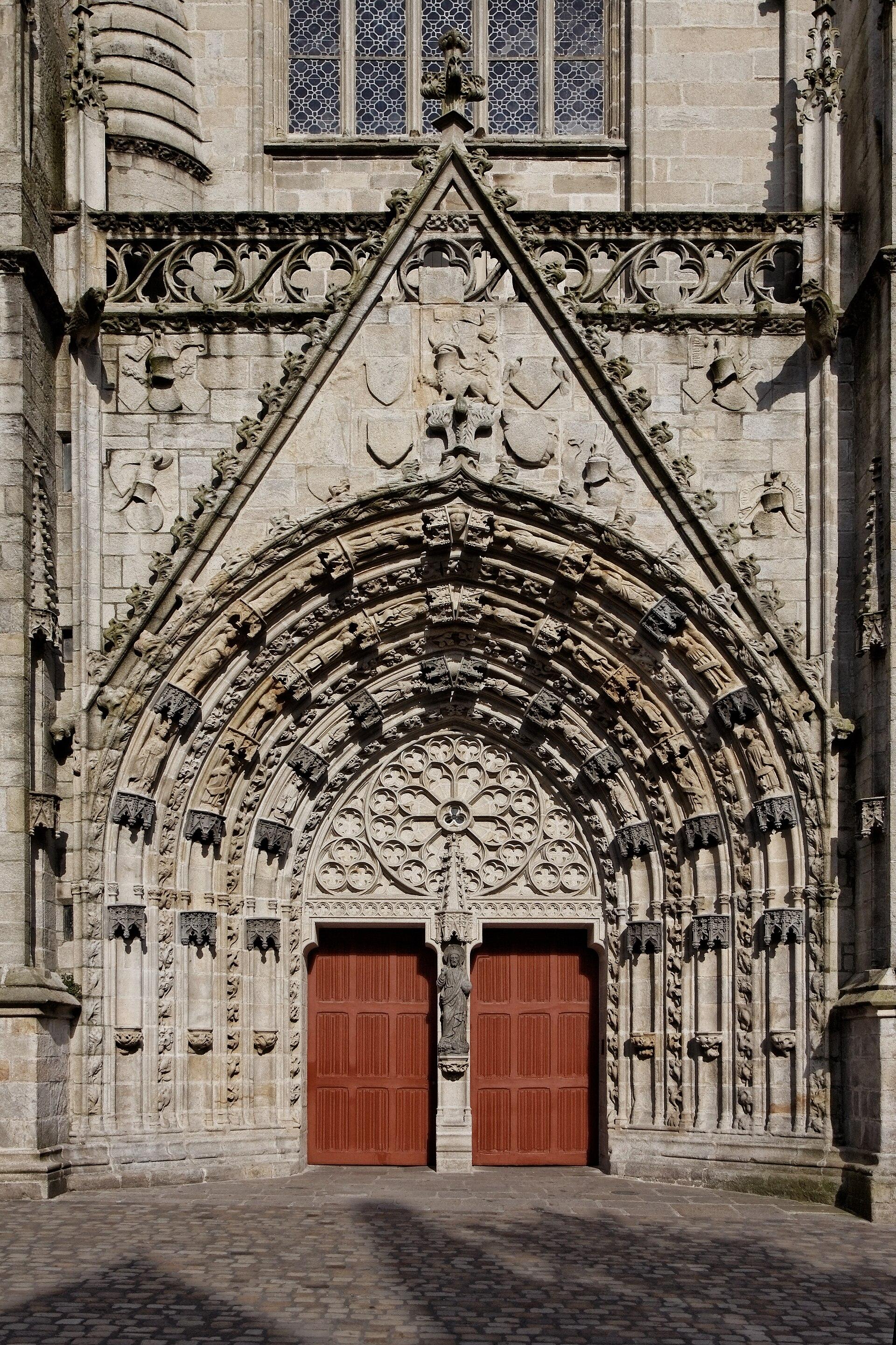
The capital of Cornouaille, where three rivers meet, around a 92-metre Gothic cathedral whose choir is out of line with the nave.
- Suggested time
- A full day
- Type of place
- Ville d’art et d’histoire and Gothic cathedral
- Atmosphere
- Episcopal, bustling and full of flowers
- Getting there
- Pedestrian historic centre, easy on foot; cobbles and a few slopes towards the gardens
Who this place suits
- With family
- 9/10
- As a couple
- 9/10
- With friends
- 8/10
- Solo
- 9/10
- With a dog
- 7/10
- Reduced mobility
- 6/10
These scores are calculated from what the page records: official rating, facilities, difficulty, duration and location. They are a guide, not a substitute for contacting the venue, especially about accessibility.
About
Quimper takes its name from the Breton Kemper, meaning confluence. Three rivers meet here, the Odet, the Steïr and the Frout, and the whole town makes sense from there: the flower-lined quays, the footbridges, the bishop’s centre squeezed between the rivers, and the districts climbing towards Mont Frugy. The historic capital of Cornouaille, the prefecture of Finistère and a Ville d’art et d’histoire since 1989, it is above all a town best explored on foot, from one monument to the next, over a few hundred metres. At its heart stands Saint-Corentin cathedral, whose two spires are the landmark of the whole town. The building was not built in one go: it tells the story of six centuries of work. The Gothic choir was begun in 1239 by Bishop Raynaud, on the site of a Romanesque choir, on the model of the great cathedrals of the Île-de-France. Its vaults were only completed in 1410, as the War of the Breton Succession long slowed the work. In 1424, Bishop Bertrand de Rosmadec began the nave and the two west towers, finished around 1460. And the spires, the ones everyone photographs, are not medieval at all: they date from 1854 to 1856, by the Quimper architect Joseph Bigot, and were largely funded by a subscription from the townspeople, the “sous de saint Corentin”. The whole building is about 92 metres long and rises to more than 75 metres. Step into the nave and look towards the far end: the choir is out of line. It is the most talked-about curiosity in Brittany, and nobody knows why. One symbolic tradition sees in it the tilted head of Christ on the cross, a lovely reading but never proven. A technical explanation suggests the search for stable ground, away from the damp land of the Odet. Recent research points rather to an existing chapel of Notre-Dame that the new choir had to work around. Sources do not even agree on the size of the shift, from two and a half to about ten degrees depending on how it is measured. The interior holds another surprise: the restoration carried out at the end of the 20th century uncovered the old paintwork, yellow and red ochre on the ribs, and you realise that medieval cathedrals were not the grey stone buildings we imagine. The town behind the cathedral is as rewarding as the monument. Seventy-three half-timbered houses survive, from the 16th to the 19th century, clustered around Rue Kéréon, which offers the finest view of the spires, and Place Terre-au-Duc. These two hubs are no accident: in the Middle Ages, Quimper was divided between the power of the bishop, in the walled town, and that of the Duke of Brittany, across the Steïr. Ramparts survive near the Jardin de la Retraite, where the shelter of the walls creates a microclimate in which banana trees and palms grow a few steps from the cathedral. Yet the oldest part of Quimper lies elsewhere, a twenty-minute walk down the Odet. At Locmaria, a Gallo-Roman port developed from the 1st century, with its iron, bronze and pottery workshops, and its Romanesque church from the 11th and 12th centuries is among the oldest monuments in town. It was also here that, in 1690, Jean-Baptiste Bousquet set up his workshop and Quimper faience was born, more than three centuries of production that is still alive today. Antiquity, bishop’s city, faience: walking down the river, you travel through the town in the order of its history.
What you will see
- A 92-metre Gothic cathedral, built from the 13th to the 19th century
- The choir out of line with the nave, an architectural mystery never solved
- Spires from 1854-1856, funded by a subscription from the townspeople
- The statue of King Gradlon between the two towers, put back in 1858
- Medieval paintwork uncovered during restoration: the stone was not grey
- Late 15th-century stained glass, with the kneeling donors of Cornouaille
Show 4 more pointsHide
- The great organ with a case by Robert Dallam, an English organ builder, mid-1640s
- Seventy-three half-timbered houses, Rue Kéréon and Place Terre-au-Duc
- The Jardin de la Retraite, banana trees and palms sheltered by the ramparts
- Locmaria, a Gallo-Roman port, a Romanesque church and the birthplace of faience since 1690
Practical information
- Address
- Place Saint-Corentin, 29000 Quimper
- Public transport
- Quimper station, with links to Paris, Rennes, Lorient and Vannes among others; ten to fifteen minutes’ walk to the cathedral, following the Odet and then the spires. The QUB City electric shuttle is free, and the whole QUB network is free for everyone at weekends; check before you come
- Parking
- About 5,600 spaces in the centre, nearly 2,200 of them free, according to the town. Half an hour free on the street with a ticket or the app, and several car parks offer one to two hours free, more near the station. For a full day, choose a long-stay or outlying car park and explore the centre on foot
- Pets
- Exploring outdoors works very well with a dog on a lead. Indoor access depends on each site: do not count on taking a pet into the cathedral or the museums
- Accessibility
- The historic centre is fairly accessible on its main streets, and the cathedral is accessible at its main level. Cobbles, a few slopes and the constraints of old buildings remain difficulties, and the Jardin de la Retraite has steps between its areas. The Musée départemental breton has accessibility equipment
- Best time
- Spring and September for the gardens and flower-lined quays. Morning for a quiet cathedral, late afternoon for the old streets. A great destination in rainy weather
Tips on the spot
- Step into the nave and look towards the choir: the shift is visible at once, and it is the thing not to miss
- Come around 10 am: the cathedral is quieter early in the morning
- It is an active place of worship: during a mass, a wedding or a funeral, visit discreetly or wait
- Walk up Rue Kéréon towards the facade: it is the most photographed view in town
- Look up at the ribs of the vaults to see the ochres uncovered during restoration
Show 3 more tipsHide
- Look for the statue of Gradlon between the two towers, and the pulpit carved with the legends of Saint Corentin
- Climb to the Jardin de la Paix, above the Jardin de la Retraite, for the view of the spires
- Allow a full day to understand the town: the centre in the morning, Locmaria and the faience in the afternoon
Frequently asked questions
What does the town’s name mean?
Kemper, in Breton, means confluence. Three rivers meet here: the Odet, the Steïr and the Frout.
What are the opening hours?
Every day from 10 am to 12 noon and 3 pm to 6 pm, according to the usual published times. They may change during services or events.
Can I visit during a mass?
The cathedral is an active place of worship. During a mass, a wedding or a funeral, visit discreetly or wait.
How long does the cathedral take?
Twenty minutes for a quick look, thirty to forty-five minutes for a normal visit, an hour to see everything.
When was the cathedral built?
Gothic work began in 1239 and spread over six centuries. The choir vaults were finished in 1410, the nave and towers between 1424 and 1460, and the spires from 1854 to 1856.
Are the spires medieval?
No, and it surprises many visitors: they date from 1854-1856, by the Quimper architect Joseph Bigot. The towers stood without them for centuries.
See also all the heritage in Brittany.
Stay in Quimper
Places to stay that are still available, with current prices, compared across the main booking platforms.
Partner link: a booking made from this map may earn us a commission, at no extra cost to you.
Read in the journal
- SeasonWhat to do in Quimper during the All Saints’ holidaysThe Cathédrale Saint-Corentin, the old town, faience, the Halles Saint-François, Locronan and Concarneau: our ideas for the 2026 All Saints’ holidays in Quimper.
- City guideWhat to do in Quimper: the complete guideThe Cathédrale Saint-Corentin, the old town, the banks of the Odet, the Breton museum, Locronan and the Pointe du Raz: what to do in Quimper, the capital of Cornouaille.
- Winter holidaysWhat to do in Quimper during the February holidaysThe cathedral and the old town, the Breton museum, the Halles Saint-François, Locronan and the Pointe du Raz in winter: our ideas for the February 2027 holidays in Quimper.
Traveller reviews
Nobody has reviewed this place yet.
Photograph: Thesupermat · CC BY-SA 3.0 · Wikimedia Commons