Heritage site
Great Cairn of Barnenez
Plouezoc’h · Finistère
The largest megalithic monument in Europe: eleven passage graves under a dry-stone cairn, older than the pyramids.
- Suggested time
- 1 hour
- Type of place
- Neolithic cairn
- Atmosphere
- Primordial
- Getting there
- Plouezoc’h · site car park, interpretation centre
Who this place suits
- With family
- 7/10
- As a couple
- 8/10
- With friends
- 7/10
- Solo
- 9/10
- With a dog
- 1/10
- Reduced mobility
- 4/10
These scores are calculated from what the page records: official rating, facilities, difficulty, duration and location. They are a guide, not a substitute for contacting the venue, especially about accessibility.
About
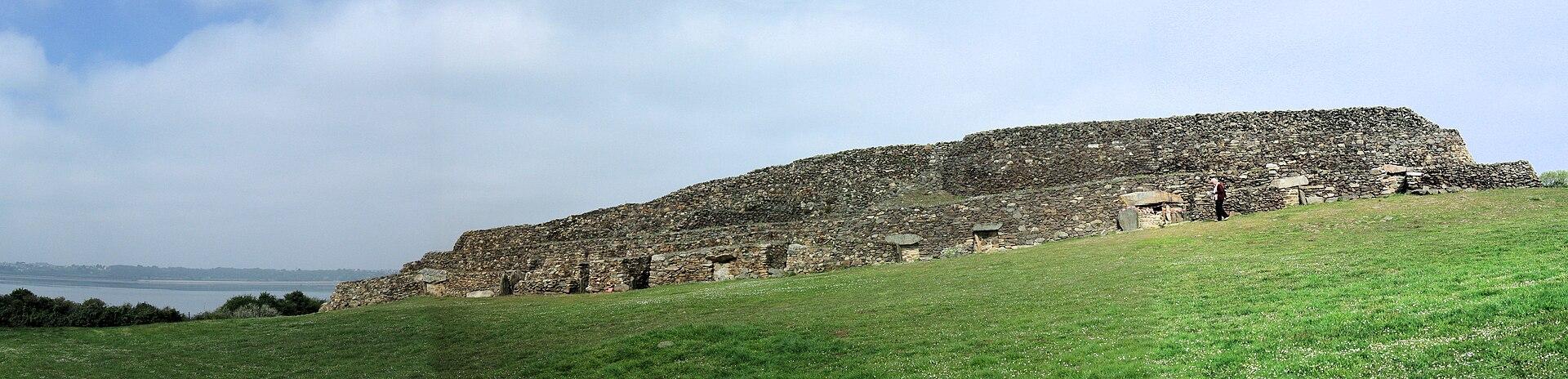
Six and a half thousand years ago, long before the first stone of the pyramids and before Stonehenge, Neolithic communities piled four thousand tonnes of dry stone on a ridge overlooking the Bay of Morlaix. They had no metal, no wheel and no writing. Yet they built a mausoleum seventy metres long and nearly eight metres high, holding eleven passage graves, and they built it so precisely that some vaults still stand today, without a gram of mortar. Barnenez is the largest megalithic monument in Europe, and one of the oldest buildings made by humans to have survived to our day. The monument was not raised in one go. A first cairn, to the east, covers chambers G, G’, H, I and J: these are the oldest, dated between 5010 and 4400 BC. Later, the builders added a second cairn against it to the west, with chambers A to F, the most recent of which dates from between 4550 and 3895 BC. Between the two lie several centuries, perhaps dozens of generations who kept enlarging the same tomb. It reads less like a building site than like a tradition passed down. The construction shows a surprising skill for its time. The passages and chambers are built of stacked slabs and rubble stones, each course jutting slightly beyond the one below, until the vault closes at the top: these are corbelled false domes, a solution architecture would use again thousands of years later. The builders also chose their stones. The dark local dolerite makes up the mass, but pale granite, brought from Île Stérec and the Plougasnou area one or two kilometres away, was kept for the facings and the inner structures. It is not a heap: it is masonry, with materials given specific roles. That Barnenez is still here is close to a miracle. In spring 1955, the cairn, mistaken for a simple pile of stones, was blasted with explosives to be used as a quarry for fill. The blasts tore open the back of four chambers in the western part before the alarm was raised. Listed as a historic monument on 18 January 1956, the site was saved, and Pierre-Roland Giot led excavations and restoration there from 1955 to 1968, one of the founding projects of French Neolithic archaeology. The quarry wound has remained visible, and it turned into an opportunity: the cut opened by the explosives shows the inside of the monument from outside, its chambers in a row and its stacked courses. Nowhere else can you read a cairn of this size as if in cross-section. There remain signs that no one has been able to read. In the passage of chamber J, there is an engraved rectangle with radiating lines, often called the shield. In chamber H, there are triangular axes, bows, U-shaped signs, crosses and wavy lines pecked into the stone, with traces of red iron oxide and black manganese dioxide paint found in 2012. They are among the oldest megalithic engravings known in Brittany, and their meaning escapes us entirely. You come to Barnenez for an architecture that has stood for six thousand years, and you leave with the clear feeling that what matters most here can no longer be told.
What you will see
- The largest megalithic monument in Europe, and one of the oldest buildings still standing
- Eleven passage graves under a single cairn, built in two phases several centuries apart
- Corbelled false domes still intact after six thousand years, built without any mortar
- The cut opened by the 1955 quarry, which shows the inside of the monument from outside
- Engravings among the oldest in Brittany: axes, bows, U-shaped signs, a radiating shield
- Traces of red and black paint found in 2012 in chamber H
Show 4 more pointsHide
- A deliberate choice of materials: dark dolerite for the mass, pale granite for the facings
- A natural lookout over the Bay of Morlaix, the Morlaix river and the Château du Taureau
- The excavations of Pierre-Roland Giot, a founder of French Neolithic archaeology
- A stop on the Vélomaritime, with the Accueil Vélo label and free parking
Practical information
- Address
- 111 route du Cairn, presqu’île de Kernéléhen, 29252 Plouezoc’h
- Public transport
- Morlaix station is about ten kilometres away, then a BreizhGo coach or a taxi. The site can also be reached by bike on the Vélomaritime (EuroVelo 4) and holds the Accueil Vélo label.
- Parking
- Free parking at the site entrance.
- Pets
- Dogs are not allowed on the site; assistance dogs are welcome in the visitor building and on the route.
- Accessibility
- Not accessible independently in a wheelchair: the route follows natural ground with slopes and steps. A secondary access is provided for disabled visitors, and entry and the guided tour are free for them and their companion with proof. An adapted offer exists for blind and partially sighted visitors. Call the monument beforehand.
- Best time
- May, June and September for the light and the calm. Morning or late afternoon in high summer, as the visit has no shade.
Tips on the spot
- Allow an hour to an hour and a half to walk round the cairn and read the panels without rushing
- Start with the west face, the quarry side: the chambers in cross-section give you the key to the monument before anything else
- The visit is entirely outdoors and has no shade; bring water, a hat and sun cream in summer, a windproof jacket the rest of the year
- The chambers cannot be entered: the route goes around and above the cairn
- Low morning or late-afternoon light picks out the courses of stone; midday sun flattens them
Show 7 more tipsHide
- Take a guided tour or the booklet if you want to spot the engravings: they are discreet and easy to miss
- Last entry to the monument is thirty minutes before closing; check the times before you go
- Dogs are not allowed on the site, except assistance dogs: plan accordingly
- With a pushchair, it is possible but uncomfortable: the ground and slopes make a baby carrier a better choice
- Walk up to the viewpoint over the Bay of Morlaix, often overlooked although it explains why the cairn was built here
- Do not climb on the cairn and stay on the paths: the masonry is dry and a single push can move it
- Combine the visit with the bay: Morlaix and its viaduct, the Château du Taureau, Plougasnou and the Pointe de Primel
Frequently asked questions
How old is the cairn?
Between six thousand and six and a half thousand years old. The dates range from 5010-4400 BC for chamber G to 4550-3895 BC for chamber A: the monument was built in two phases.
How many chambers are there?
Eleven passage graves, identified by letters: G, G’, H, I and J in the primary cairn to the east, A to F in the secondary cairn to the west.
How big is the monument?
The Centre des monuments nationaux gives 70 m long and nearly 8 m high. The archaeological literature gives 75 m for the restored monument, 90 to 95 m when it was discovered, and 6 m of surviving height. The difference lies between the excavated and the restored monument.
Can you go inside the chambers?
No. The route goes around and above the cairn. The passages and chambers are seen from outside, including through the cut opened on the west side.
What is the quarry cut?
In spring 1955, the cairn, mistaken for a pile of stones, was blasted with explosives to be used as a quarry for fill. The blasts tore open the back of four chambers on the west side. The wound has stayed visible, and today it shows the inside of the monument in cross-section.
Who excavated the site?
Pierre-Roland Giot, from 1955 to 1968. His excavations and the restoration that followed are among the founding projects of French Neolithic archaeology.
See also all the heritage in Brittany.
Stay in Plouezoc’h
Places to stay that are still available, with current prices, compared across the main booking platforms.
Partner link: a booking made from this map may earn us a commission, at no extra cost to you.
Read in the journal
- ChristmasWhat to do in Finistère during the Christmas holidaysChristmas at Trévarez, the Quimper Christmas village, Locronan lit up, Océanopolis and wild headlands: our ideas for the 2026 Christmas holidays in Finistère.
- SeasonWhat to do in Finistère during the All Saints’ holidaysThe Pointe du Raz, Océanopolis, the Huelgoat forest, spring tides and the legends of the Monts d’Arrée: our ideas for All Saints’ 2026 in Finistère.
- RankingThe most beautiful beaches in FinistèreLa Torche, the Baie des Trépassés, Les Blancs Sablons, Morgat, Raguénez and the white sand of Léon: our selection of the most beautiful beaches in Finistère, for everyone.
Traveller reviews
Nobody has reviewed this place yet.
Photograph: Gerhard Haubold · CC BY-SA 3.0 · Wikimedia Commons