
Heritage site
Vannes walled town
Vannes · Morbihan
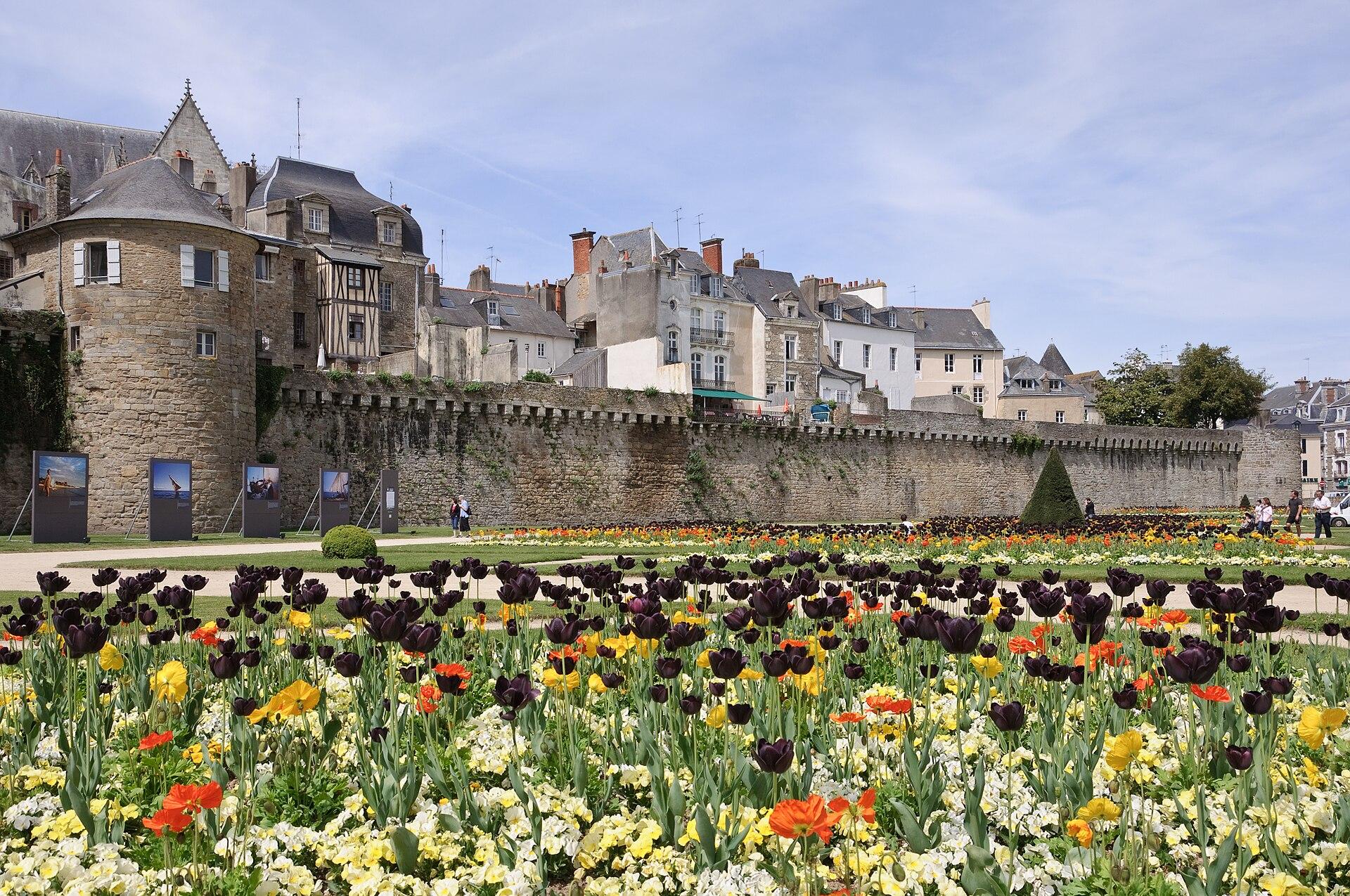
A walled town in Morbihan that keeps nearly a kilometre of ramparts, five of its seven gates and two thousand years of continuous urban history.
- Suggested time
- Half a day
- Type of place
- Walled town and Town of Art and History
- Atmosphere
- Medieval, flower-filled and lively with shops
- Getting there
- A pedestrian historic centre, with car access strictly controlled by bollards: park at the harbour or on the outskirts
Who this place suits
- With family
- 10/10
- As a couple
- 10/10
- With friends
- 9/10
- Solo
- 10/10
- With a dog
- 8/10
- Reduced mobility
- 8/10
These scores are calculated from what the page records: official rating, facilities, difficulty, duration and location. They are a guide, not a substitute for contacting the venue, especially about accessibility.
About
Vannes began as a Roman town. At the end of the 1st century BC, a town called Darioritum was founded on the Boismoreau hill and became the centre of the territory of the Veneti, the Gaulish people whose fleet had fought Caesar in 56 BC. But the walled town you walk through today is not there: at the end of the 3rd century, in an unstable period, a fortified castrum was built on the neighbouring Mené hill. This is the ancestor of the walled town, and parts of its ancient wall are still embedded in today’s ramparts to the north. Darioritum became Venetis in the 5th century, then Vannes, Gwened in Breton, and the urban heart moved for good to the castrum, around the cathedral. The other date that made the town is 1370. Duke John IV decided to enlarge the town to the south, because the port was growing and the walls had become too tight. The area went from about five to ten hectares, almost double, and the port ended up at the foot of the walls. In the 1380s, the same duke built the Château de l’Hermine, a ducal residence built into the ramparts. Beware of the name: the building now called the Château de l’Hermine is not that one. The medieval remains were largely removed in 1797, and the visible building is the Hôtel Lagorce, from the late 18th century, built on the site. Excavations in 2023 and 2024 found the ducal castle underground. What remains is exceptional: about a kilometre of ramparts, nearly three quarters of the historic walls, and five of the seven original gates. These walls span seventeen centuries, from the Gallo-Roman wall to the 16th and 17th century bastions, via 15th century towers. Worth knowing before you come: you cannot walk along the top. Unlike Saint-Malo, there is no continuous wall walk with free access, as much of it is private, closed or only open on guided tours. The walk is at the foot of the walls, and it is magnificent: the Marle river still flows in the old moats, the rampart gardens bloom beneath the Constable’s Tower, and the Garenne wash houses line up their wooden galleries by the water. These wash houses look medieval; they date from 1817 to 1821. Inside, the town is made for walking. The centre is largely pedestrian and compact: in a few minutes you go from the monumental Porte Saint-Vincent, topped by Saint Vincent Ferrer, to the Place des Lices and its market, then to the Place Henri-IV, the finest group of half-timbered houses in town. Vannes has about one hundred and seventy of them across the whole municipality, not just inside the walls: in the 15th century there may have been nearly nine hundred, and the town was then almost entirely wooden. At the corner of Rue Noé, two 16th century stone busts watch passers-by from the first floor. They are called Vannes and his wife, and no one knows who they represent. Check what is open, as the town is changing. Saint-Pierre cathedral, where Saint Vincent Ferrer rests, has been fully closed since 20 September 2026 for the last phase of its restoration, with reopening announced for 27 June 2027: you can only see it from outside, and masses are held in the Saint-Yves chapel. La Cohue, the former 13th century medieval market hall that became the Fine Arts Museum, is due to close after the 2026 All Saints’ holidays to prepare the move of its collections to the future Musée de l’Hermine, expected in 2028. Château Gaillard, the town’s oldest stone mansion, has been closed since 2022. None of this takes away the old centre, its gates, gardens and harbour, which are free and intact; but it is better to know before you travel.
What you will see
- Nearly a kilometre of ramparts preserved, three quarters of the historic walls
- Seventeen centuries of military architecture layered together, from the Gallo-Roman wall to modern bastions
- Five of the seven original gates, including the Porte Saint-Vincent and the Porte Prison
- The Constable’s Tower, both defensive and residential, overlooking the gardens
- The rampart gardens and the Marle in the old moats, the very image of Vannes
- The Garenne wash houses, from 1817 to 1821, not medieval despite appearances
Show 4 more pointsHide
- Place Henri-IV, the finest group of half-timbered houses in town
- Vannes and his wife, two 16th century busts that no one has ever identified
- La Cohue, a 13th century medieval market hall that once housed the Parliament of Brittany
- A compact pedestrian centre where everything is on foot, ten minutes from the station
Practical information
- Address
- Intra-muros, 56000 Vannes
- Public transport
- Vannes station, served by TGV, is about 1 km from the historic heart, ten to fifteen minutes’ walk: an easy destination without a car. Kicéo buses serve the centre. A little tourist train runs in season, from 4 April to 1 November in 2026.
- Parking
- Do not try to drive into the walled town: the centre is largely pedestrian and retractable bollards control access. Port car park, about 405 spaces, the most practical for the Porte Saint-Vincent; République, about 317 spaces; La Loi, about 146 spaces; plus the Centre car park and outlying car parks, for nearly 5,500 spaces across the town. On-street, about twenty free minutes per half day with a ticket or the app; paid parking Monday to Saturday except public holidays, free on Sundays and public holidays in the red and green zones. For a full day, use an underground or outlying car park.
- Pets
- The outdoor walk works very well with a dog on a lead, under town rules. Museums generally do not admit pets, and do not count on access to religious buildings.
- Accessibility
- Fairly good for a medieval town: the historic heart is compact, largely pedestrian and often fairly flat. The rampart gardens, the harbour and Place des Lices are easy, and Place Henri-IV remains accessible despite its cobbles. There are still cobbles, some slopes, narrow paths and the constraints of old buildings. The CIAP heritage centre in the Hôtel de Limur obtained the Tourisme et Handicap label in 2026 for all four types of disability (motor, visual, hearing and mental). The ramparts themselves cannot be accessed from the top.
- Best time
- April, May, June and September; September is probably the best month. Before 9 am for calm and light, winter for the architecture without the crowds.
Tips on the spot
- Do not try to climb onto the ramparts: there is no continuous wall walk with free access as in Saint-Malo.
- The real walk is at the foot of the walls, along Rue Francis-Decker and in the rampart gardens.
- Enter via the harbour and the Porte Saint-Vincent: you immediately understand the link between the town, the port and the walls.
- The cathedral is closed until the announced reopening on 27 June 2027: outside only.
- Start at the CIAP heritage centre in the Hôtel de Limur, which is free, to understand the town before exploring it.
Show 6 more tipsHide
- Allow two hours minimum, half a day for a proper visit.
- On market days, Wednesday and Saturday mornings, the town is superb and packed: choose according to what you want.
- Before 9 am, Place Henri-IV is almost empty: the time for photographers.
- Do not try to drive into the walled town: retractable bollards control access. Park at the Port car park for the Porte Saint-Vincent, or on the outskirts for a full day.
- The gardens are at their best from May to September, with the best light in the morning.
- After rain, the cobbles and colourful facades make the best pictures of the centre.
Frequently asked questions
What is Vannes Intra-Muros?
The historic heart of Vannes, inside the old fortified walls. The term means “within the walls” and does not cover the whole town centre or the whole municipality.
How old is the town?
More than two thousand years old. A Gallo-Roman town, Darioritum, was founded at the end of the 1st century BC on the Boismoreau hill.
Who were the Veneti?
A powerful Gaulish people from the south of today’s Morbihan, known for their fleet, who fought Caesar’s armies in 56 BC. Darioritum became the centre of their territory in Gallo-Roman times.
Is today’s walled town the Roman town?
No. The ancient town was mainly on the Boismoreau hill, further east. The walled town corresponds to the fortified castrum built at the end of the 3rd century on the neighbouring Mené hill.
What does Gwened mean?
It is the Breton name for Vannes. Like Vannes, it comes from the name of the Veneti: Darioritum became Venetis in the 5th century, then Vennes and Vannes.
When did the walled town take its present shape?
Around 1370, when Duke John IV extended it to the south. The area went from about five to ten hectares, almost double, and the port ended up at the foot of the walls.
See also all the heritage in Brittany.
Stay in Vannes
Places to stay that are still available, with current prices, compared across the main booking platforms.
Partner link: a booking made from this map may earn us a commission, at no extra cost to you.
Read in the journal
- ChristmasWhat to do in Vannes during the Christmas holidaysChristmas in the old town from 7 to 31 December, illuminated ramparts, the Gulf in winter and the Château de Suscinio: our ideas for the 2026 Christmas holidays in Vannes.
- SeasonWhat to do in Vannes during the All Saints’ holidaysThe Vive la Magie festival, the funfair, Halloween at Branféré, Suscinio, the Gulf and Carnac open to walkers: our ideas for All Saints’ 2026 in Vannes.
- City guideWhat to do in Vannes: the complete guideRamparts and wash houses, the old town, the harbour, cruises to the Île aux Moines and the Île d’Arz, the Château de Suscinio: what to do in Vannes and the Gulf.
Traveller reviews
Nobody has reviewed this place yet.
Photograph: Myrabella · CC BY-SA 3.0 · Wikimedia Commons